AI Revolution: Innovation & AI: Reimagining Insurance Risk with Ashish Srivastava
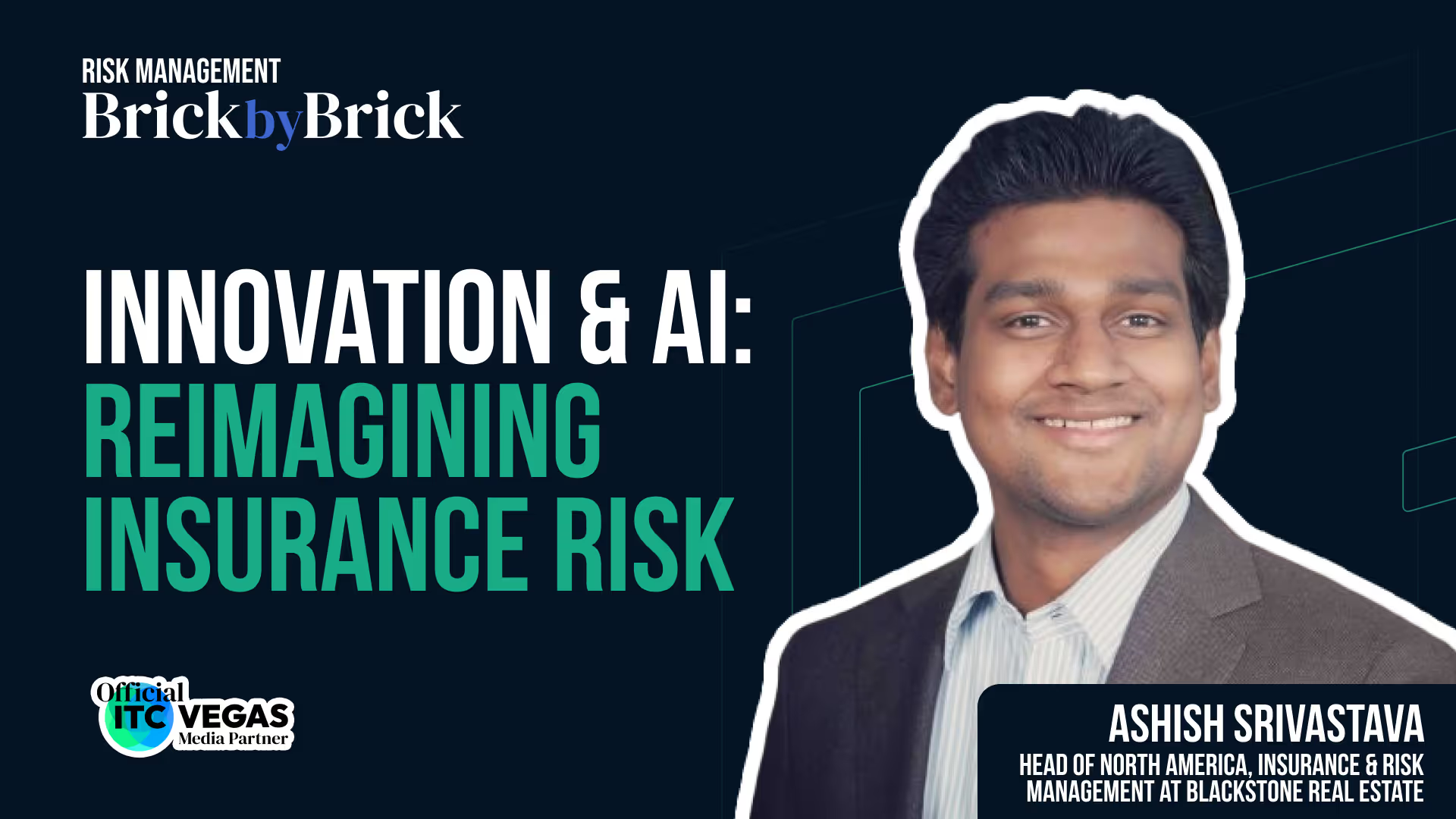
In a recent episode of Risk Management: Brick by Brick, host Jason Reichl sits down with Ashish Srivastava, Head of North America, Insurance & Risk Management for Blackstone Real Estate, for an unfiltered conversation about the insurance industry's innovation problem. From his vantage point managing one of the world's largest real estate insurance portfolios, Ashish reveals why the gap between what customers need and what the market delivers is widening—and why companies that prioritize innovation over brand names will win the future.
To find out how TrustLayer manages risk so that people can build the physical world around us, head to TrustLayer.io.
Portfolio Scale Creates Strategic Advantages
Ashish's role at Blackstone puts him at the intersection of strategy and execution across multiple portfolio companies and asset classes. The scale itself creates powerful advantages: "The pooling of the assets creates an inherent diversification when we go to market as a big program. It also gives us more edge over the carriers and brokers because of the scale."
But scale alone isn't the story. Insurance represents the second-largest cost in real estate after property taxes, making it a critical factor in investment decisions. By staying involved from acquisition through disposition, Ashish ensures insurance remains a competitive advantage rather than just an operational expense.
This holistic approach means thinking strategically about every phase of the real estate lifecycle. When insurance is treated as a strategic advantage rather than a cost center, it directly impacts the investment hypothesis. In an industry where margins are razor-thin, this approach can make the difference between a successful investment and a missed opportunity.
The Innovation Gap in Insurance
When asked about his upcoming presentation at the insurance conference, Ashish doesn't mince words about the industry's pace of change: "The insurance market has been slow to innovation. Even the brokerage firms have been slow to innovation because there hasn't been a case for change."
The problem isn't lack of experimentation—carriers and brokers are investing in technology. But innovation happens behind the scenes without customer input. They operate in a vacuum, rarely hearing directly from buyers about what they actually need. The result? Despite significant technology investments, the customer experience remains largely unchanged from five years ago.
Ashish believes InsurTechs are positioned to bridge this gap precisely because they start with customer needs rather than legacy systems. His hope is to provide an unfiltered perspective that tells carriers and brokers what customers actually need versus what they're getting. Traditional players tinker with existing processes; InsurTechs can reimagine them entirely.
Flipping the Script with AI and Risk Prevention
The current insurance process remains stubbornly renewal-focused, with broker value measured primarily by cost savings achieved. Ashish wants to flip this script: "How can we prevent losses before they happen? The best kind of claims are the ones that don't happen."
AI makes this transformation possible through practical applications already showing results. Water leakage sensors that detect problems the moment they happen—or even before. Pattern recognition analyzing claims and loss history to guide capital expenditure decisions toward highest-impact resilience improvements.
One compelling example: installing cameras in affordable housing properties costs just a few hundred dollars but can prevent multimillion-dollar claims. While the claim goes to the insurance market, it also impacts premiums long-term. These aren't theoretical use cases—they're initiatives Ashish's team is actively pursuing.
The goal is using AI to determine where investments deliver the most bang for the buck based on actual data. While these efforts are still in the beginning stages, the vision is clear: embed proactive risk prevention into business-as-usual operations rather than treating them as special projects.
The "Three in a Box" Model for AI Success
From his experience at McKinsey and Zurich, Ashish has seen what works for carriers and brokers implementing AI successfully. The answer isn't choosing between hiring external talent or developing internal capabilities—it's creating cross-functional pods he calls "three in a box".
First, a traditional underwriter or claims adjuster who understands how decisions actually get made. Second, an AI specialist—whether data scientist or engineer—who can replicate that decision-making through technology. Third, someone from IT or systems who can actually implement solutions. The underwriter explains the decision process, the systems person makes it happen, and the AI specialist replicates it through artificial intelligence.
This structure requires strong leadership alignment on speed, investment level, and strategic priorities. Carriers need to decide how fast they want to go and how much they want to invest. The strategic end-to-end prioritization—where the value will come from—becomes critical.
The best results come when you put different teams together, whether by hiring external talent or deploying internal people who already have the necessary skills. But without leadership support and clear decision-making, even the best pod structure will struggle to deliver meaningful results.
Innovation Over Brand Names
When it comes to selecting insurance partners, Ashish challenges conventional wisdom about sticking with recognizable names. Brand recognition only goes so far. What matters more: "Innovation is extremely important. It's one of our big criteria when we look at potential partners."
He looks for partners with expertise handling program complexity and bench strength to manage constant portfolio changes—Blackstone acquires and sells properties daily, literally on a daily basis. The best brokers bring alternative risk transfer strategies, captive structure innovations, and InsurTech partnerships that enhance the overall insurance program.
Traditional brokers who rely on relationships and renewal-focused thinking ("I know this guy at that carrier and I'm going to get you the best pricing") are being left behind. The brokers that stand out during RFPs are the ones investing in technology—you can tell immediately. They're the ones thinking throughout the year, not just from renewal to renewal, viewing insurance as a collaborative partnership rather than a transactional service.
Advice for Risk Managers: Curiosity and Influence
For risk managers wondering how to keep pace with AI, cyber threats, and rapidly evolving responsibilities, Ashish offers straightforward guidance: "The biggest part is curiosity. That intellectual curiosity will really help them."
But curiosity alone isn't enough. Risk managers must develop influence skills tailored to their stakeholders. If you're a risk manager at a billion-dollar company, does your Chief Security Officer believe in stringent cybersecurity measures? If not, how do you convince that person? Some leaders need data. Others respond to compelling narratives. Understanding which approach works and adapting accordingly is essential.
For those entering the industry, Ashish recommends RIMS local chapters over national conferences for better-targeted content, publications like Business Insurance and Insurance Insider, and importantly, mainstream business publications like The Wall Street Journal and The New York Times to understand how insurance intersects with broader political, social, and economic dynamics.
Final Thoughts
Ashish's perspective captures someone who has seen the insurance industry from multiple angles—consultant, carrier, and now sophisticated buyer. His message is clear: the gap between customer needs and market delivery is real, measurable, and represents both a crisis and an opportunity.
Insurance plays a critical role in society, allowing businesses to operate without worrying about risk and helping people when they really need it. For the industry to fulfill this noble purpose in an increasingly complex world, carriers and brokers must move beyond behind-the-scenes innovation to deliver tangible improvements in customer experience.
As Ashish reminds us, anything that happens in the world affects insurance in some way. The question is whether carriers and brokers will actively shape that future or merely react to it.
To hear more about the intersection of innovation, risk management, and insurance strategy, tune in to this episode of Risk Management: Brick by Brick.
👉 Spotify: https://bit.ly/4ixhErN
👉 Apple Podcasts: https://apple.co/3LUnIyu
👉 YouTube: https://youtu.be/4FFhqrwu6Ko
Podcast Host: Jason Reichl
Executive Producer: Don Halliwell
You might also like