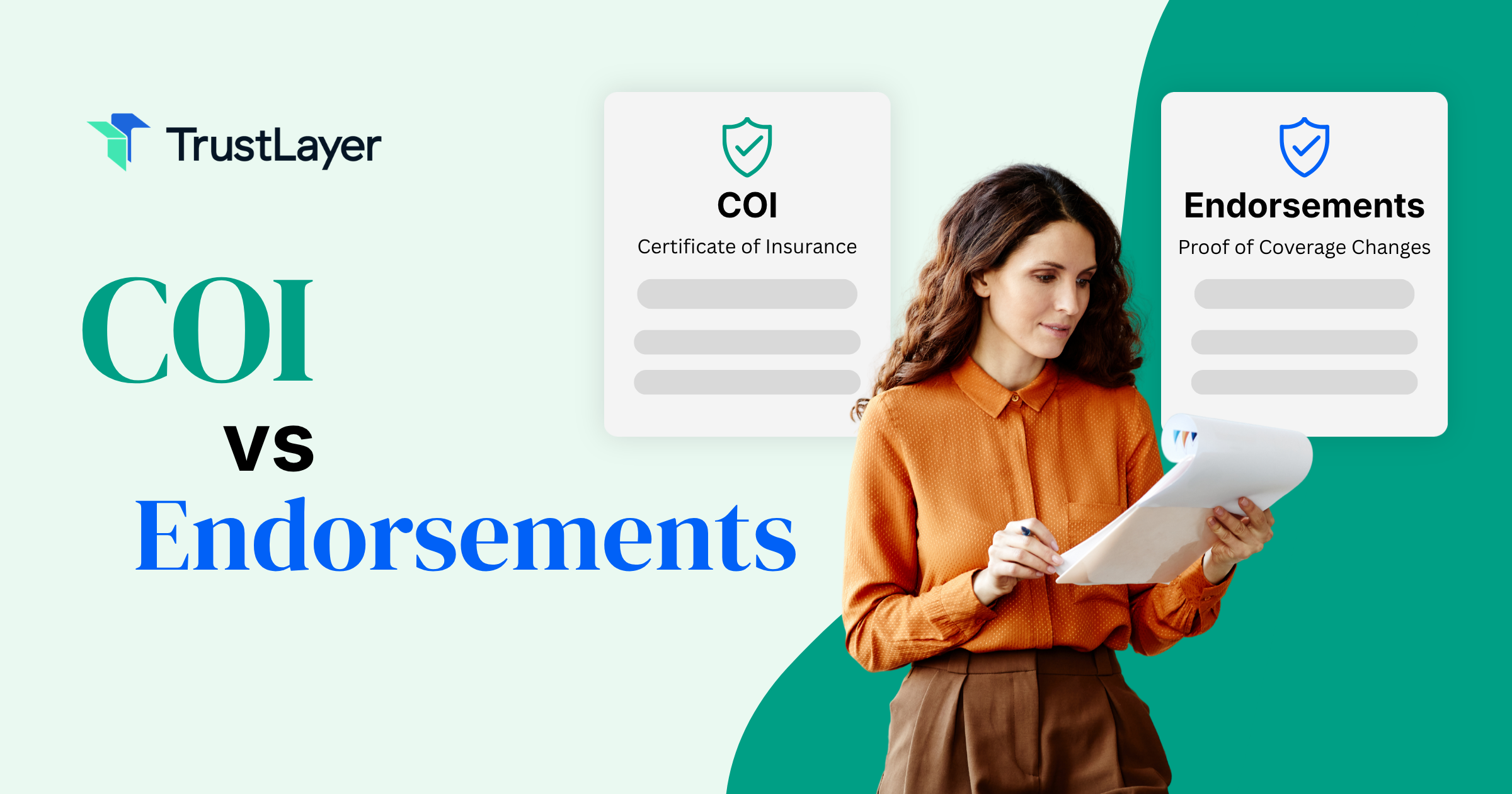
Enhanced Endorsements: The COI Is Never the Whole Story
There’s a special kind of professional dread reserved for the moment someone says:
“But the certificate shows it’s covered.”
Because you know — without even opening the file yet — that this is going to be one of those situations where the certificate page is technically “true” in the same way a movie trailer is “the whole plot.”
It’s the cover.
It’s the polite handshake.
And the endorsement?
The endorsement is where the meaning changes.
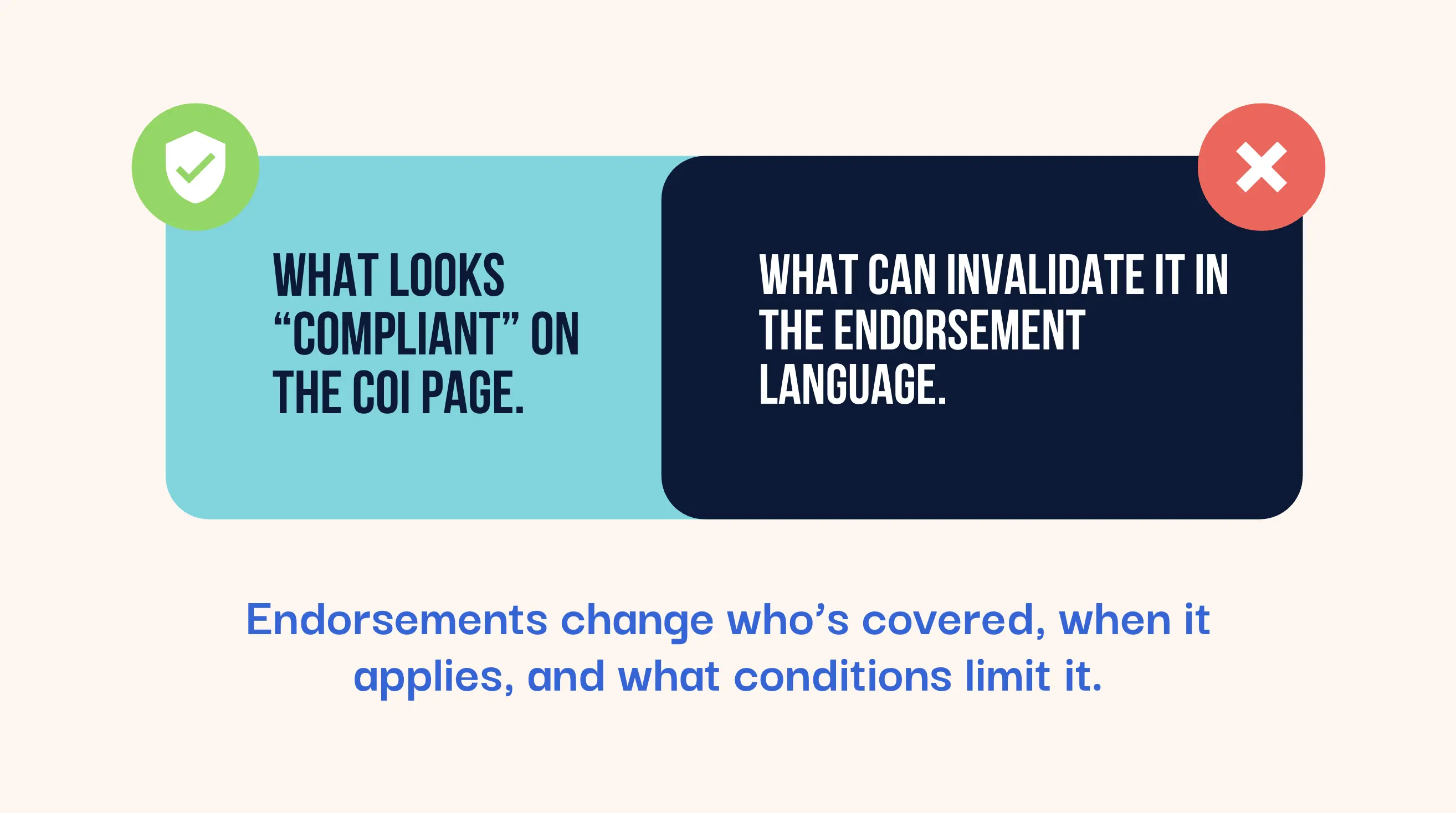
Endorsements are where coverage gets modified, narrowed, conditioned, delayed, reworded, or quietly made useless for the exact scenario the contract was written to protect against.
Which is why endorsements are also where compliance teams lose time — not because they’re careless, but because the system is designed like a scavenger hunt:
- extra pages
- attachments
- inconsistent labeling
- nonstandard form names
- language that reads like it was written by someone trying to win a bet
Enhanced Endorsements exists for one reason: to make the “hidden pages” visible — fast — inside the workflow where compliance decisions actually happen.
The Problem Isn’t Missing Coverage. It’s Missing the Change.
Most compliance breakdowns don’t happen because a vendor has no insurance.
They happen because:
- the vendor has insurance,
- the certificate page looks acceptable,
- and the endorsement changes the meaning.
That’s the trap.
A COI can say “Additional Insured: Yes” while the endorsement says “Additional Insured, but only for ongoing operations.” Which becomes a very different sentence when the claim hits after the job is done.
A COI can show a policy is active while the endorsement introduces conditions, exclusions, notice requirements, or limiting language that makes the coverage less useful than it appears.
This is how the cycle happens:
- Someone requests the COI
- Someone uploads it
- Someone checks the certificate page
- Everyone exhales
- Later: a question, a dispute, an audit, a claim, a contract review
- Someone opens the attachment stack and realizes the important part was always there… just not visible
The risk didn’t appear late.
The visibility did.
If you want a quick gut-check on vendor risk while you’re here, run the Risk Matrix or see how it works.
Why Endorsements Get Missed (Even by Good Teams)
Manual endorsement review doesn’t fail because people don’t care.
It fails because it doesn’t scale.
Here’s what teams are up against:
- Endorsements aren’t standardized across carriers
- Forms aren’t named consistently
- Some come as separate PDFs, some as appended pages, some as “Schedule of Forms” lists
- Key wording can be buried inside dense paragraphs
- High vendor volume turns “just review the endorsement” into a math problem no one wants to solve
So the workflow becomes a compromise:
- review what’s easy
- flag what’s obvious
- hope the rest doesn’t bite later
That’s not negligence.
That’s survival.
Enhanced Endorsements is what happens when survival isn’t good enough anymore.
What Enhanced Endorsements Changes
Enhanced Endorsements surfaces endorsements and key modifications from inside the document so review stops being a scavenger hunt.
Instead of endorsements being:
- buried
- inconsistent
- time-consuming
- easy to overlook
They become:
- visible
- reviewable
- easier to validate in context
- far less dependent on someone having time for a deep PDF read
This matters because it changes the shape of the work.
The old way:
Compliance decisions happen on the certificate page.
Endorsements become “later.”
The better way:
Compliance decisions include the part that changes the meaning.
Not because anyone wants more work.
Because that’s what reduces the worst kind of work: the corrective kind.
If you want to see what “visible endorsements” actually looks like, watch the Arcade demo here
The Real Outcome: Faster Review, Cleaner Follow-Up, Fewer Surprises
Enhanced Endorsements is not about reading more pages.
It’s about getting to the right page immediately.
Teams typically want the same things:
- Speed: approvals can’t stall for days
- Consistency: decisions can’t depend on who reviewed the file
- Confidence: if something is wrong, it should be visible early
- Precision: follow-up requests should be correct the first time
Enhanced Endorsements supports that by making endorsement information easier to identify and act on.
Which means:
- less time reopening documents
- less time asking vendors to resend the “missing page”
- less time debating whether the COI “counts”
- more time making decisions based on what the coverage actually says
Where Enhanced Endorsements Helps Most
1) High-volume vendor intake
When the workflow is measured in “how many today,” endorsement review becomes the first thing sacrificed. Enhanced Endorsements helps keep speed without going blind. If you’re earlier-stage or need something lightweight first, start here: TrustLayer Starter
2) Contract-driven compliance
Requirements don’t exist in a vacuum. If the contract specifies additional insured wording, waiver language, or notice obligations, endorsements are where those terms are proven — or contradicted.
3) Renewal season
Renewals are the annual reminder that time is not infinite. Endorsements that affect acceptability should be visible without a second pass.
4) “This needs to be right” industries
Construction, property, staffing, logistics — anywhere the gap between “looks fine” and “is fine” can become a very expensive misunderstanding.
The Hidden Cost Nobody Budgets For: Rework
Most teams don’t budget time for “endorsement rework,” because it shows up disguised as other tasks:
- rechecking a vendor that was “already approved”
- reopening a compliance item weeks later
- running down an endorsement after a contract dispute
- reconstructing what was received and when
It’s not dramatic. It’s just constant.
And constant work is the kind that slowly eats the week while pretending to be small.
Enhanced Endorsements reduces this category of work because it increases visibility when it still matters — during review, not after.
What to Look For in Endorsements (Even If You’re Not an Expert)
A simple truth: you don’t need to be an insurance attorney to know when something deserves a second look.
Endorsement review often comes down to three questions:
- Does the endorsement change who is covered?
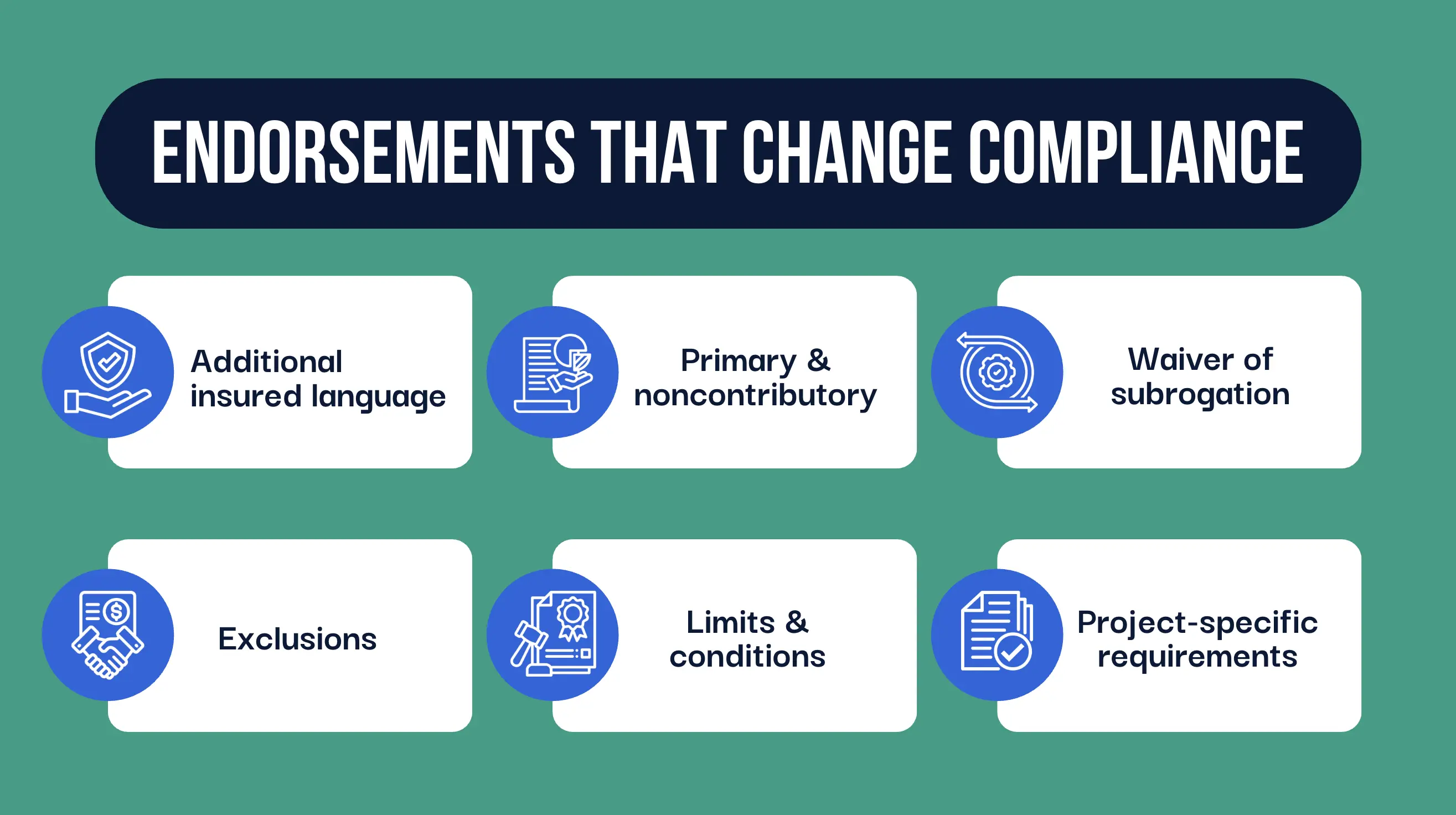
Examples: additional insured wording, primary/noncontributory language.
- Does it change when coverage applies?
Examples: ongoing vs. completed operations, project-specific limitations.
- Does it add conditions that affect enforceability?
Examples: notice requirements, restrictions, exclusions that conflict with contract expectations.
Enhanced Endorsements is built to make these “second look” items easier to spot without turning the process into a manual reading marathon.
Frequently Asked Questions Enhanced Endorsements
Q: What is an endorsement in insurance documents?
An endorsement is a policy modification that can add, remove, or change coverage terms. It’s often attached as additional pages and may materially change what the certificate page implies.
Q: Why isn’t the certificate of insurance enough?
A certificate is a summary. It may indicate coverage exists, but endorsements can change limits, wording, conditions, and applicability — making the real coverage meaningfully different.
Q: What types of endorsement language matter most for vendor compliance?
The most important items are typically those tied to contract requirements — like additional insured wording, primary/noncontributory language, waiver of subrogation, notice requirements, and limitations that affect when coverage applies.
Q: Does Enhanced Endorsements replace manual review?
It reduces manual searching and page-hunting by surfacing endorsement information more clearly. The goal is faster review with fewer blind spots — not asking teams to read more.
Q: Who benefits most from Enhanced Endorsements?
Teams dealing with high vendor volume, tight approval timelines, contract-driven requirements, and industries where “almost compliant” creates serious downstream risk.
Q: What’s the biggest operational win from Enhanced Endorsements?
Fewer “re-check this vendor” loops. The work gets done once — during review — instead of repeatedly later when someone realizes the attachment stack mattered.
Nest Steps
Endorsements shouldn’t be the thing you discover late—after approvals are given, after projects start, or after questions turn into escalations.
If endorsements are currently hiding in attachments, Enhanced Endorsements brings them into view so review is faster and decisions are more confident.
Schedule a demo to see Enhanced Endorsements in your workflow.
You might also like