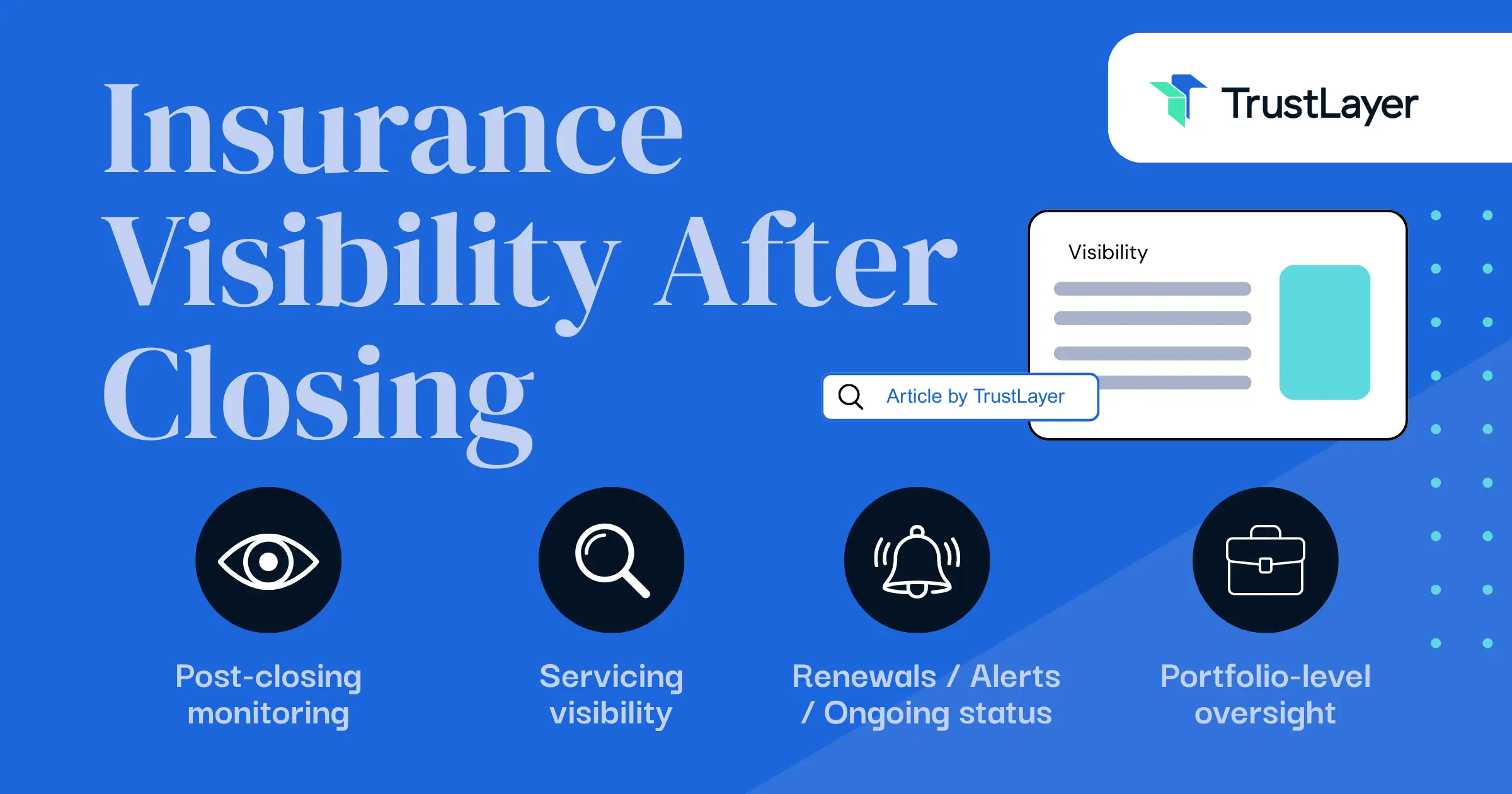
Insurance Visibility After Closing: What CRE Lenders Still Need to Track
Closing creates a dangerous kind of confidence in loan files.
The documents came in. The conditions cleared. The deal moved. Everyone involved would like to believe the insurance part is now handled and can sit quietly in the folder like a well-behaved administrative artifact.
And sometimes, for a little while, it does.
Then reality resumes.
A policy renews. A borrower changes carriers. Coverage limits shift. An endorsement is not updated. A property changes status. The servicing team inherits the file with less context than anyone expected. Someone assumes the documentation collected before closing still reflects the current truth, which would be lovely if commercial real estate loan files had any respect at all for our desire for closure.
They do not.
That is why insurance visibility after closing matters.
Because once the loan closes, the operational question changes. It is no longer simply: did we collect the required documentation?
Now it becomes:
- Is the documentation still current?
- Does the coverage still align with lender requirements?
- Has anything changed since closing?
- What is expiring next?
- What needs follow-up before it becomes a problem?
- Can servicing actually see the same reality origination that it handed off?
That is where post-closing insurance tracking starts separating the processes that only appear complete from those that actually remain useful.
What Insurance Visibility After Closing Means for CRE Lenders
Insurance visibility after closing is the ability to see whether borrower insurance documentation remains current, complete, and aligned with lender requirements after a commercial real estate loan is already active.
That includes visibility into:
- Renewals
- Lapses
- Coverage changes
- Borrower or entity changes
- Updated documentation
- Follow-up status
- Servicing handoffs
- Portfolio-level insurance status
This matters because commercial real estate loan insurance requirements do not disappear just because the original request was fulfilled once.
A loan can be closed and still become harder to trust over time if no one has clear visibility into what happened after that moment. That is the part many teams discover the hard way. The closing checklist may end. The insurance monitoring problem usually does not.
Who This Article Is For
This article is for:
- Commercial real estate lenders
- Loan servicing teams
- Portfolio risk and compliance teams
- Lending operations leaders
- Teams inheriting or managing post-closing borrower insurance workflows
If your team needs visibility into borrower coverage after the loan is already on the books, this is your problem too.
Key Takeaways About Insurance Visibility After Closing
- Insurance visibility after closing matters because borrower coverage can renew, lapse, shift, or fall out of alignment over time.
- A file that was complete at closing is not necessarily current later.
- Loan servicing insurance tracking breaks down when context gets lost across handoffs, renewals, and disconnected systems.
- Commercial real estate loan insurance requirements continue after closing, especially when borrowers, properties, or entities change.
- Better post-closing visibility helps lenders and servicers reduce risk, improve follow-up, and respond more confidently to reporting or audit requests.
For teams looking to formalize this, a guide to tracking certificates of insurance can help translate these takeaways into concrete tracking practices.
Why Insurance Visibility After Closing Matters
Closing is an event. Servicing is a condition.
That is one of the easiest ways to understand why post-closing insurance monitoring matters so much.
Origination teams are usually working toward completion. Get the file in shape. Clear the requirements. Confirm what needs to be true for the deal to close. There is a definable moment where the file is good enough to move.
Servicing is different.
Servicing is not trying to get to one moment. It is trying to maintain visibility across many moments. Renewals happen. Policies change. Borrowers evolve. Documentation ages.
Staff changes. Portfolios expand. Handoffs occur. And the question becomes less about whether the documentation was once correct and more about whether the current status is known without requiring a miniature internal investigation.
That is why insurance visibility after closing matters.
Not because the documents suddenly become more interesting after the deal closes, but because the certainty that surrounded them at closing begins to decay unless something is actively preserving it.
How Loan Servicing Insurance Tracking Works
At a basic level, loan servicing insurance tracking should help teams do four things well:
- Know what insurance-related documentation is currently on file
- Identify what is expiring, missing, or no longer aligned
- Follow up before a gap becomes material
- Maintain continuity between origination assumptions and servicing reality
That is the goal.
In practice, though, post-closing visibility often depends on inherited files, shared folders, spreadsheet notes, scattered email history, and whatever level of detail the prior team captured at the time. This is where the process becomes more fragile than people realize.
Because the real challenge is not simply storing documents after closing.
The real challenge is preserving context.
What was reviewed? What was still outstanding? What changed? What mattered most to the lender’s requirement set? What renewal date actually needs action? Which entity does this update apply to? Was this replaced already? Did anyone follow up on the discrepancy, or are we just looking at the same unresolved issue from a different angle three months later?
Those are servicing questions. And manual systems are not especially kind to them.
Why Manual Borrower Insurance Tracking Breaks Down After Closing
Manual insurance tracking becomes even more fragile after closing because the sense of urgency changes.
Before closing, the missing documentation is visible because it is in the way. It delays approvals. It blocks progress. People feel it.
After closing, the danger is quieter.
The file appears complete. The pressure eases. The work becomes more periodic, more monitoring-based, and more dependent on future attention rather than immediate necessity. Which means the process has to be good enough to surface issues without the deal itself forcing everyone to look.
That is where manual workflows start slipping.
A spreadsheet is not a monitoring strategy.
An email folder is not a system of record.
A quarterly check-in is not the same thing as clear status visibility.
And “we collected it at closing” is not a valid substitute for knowing whether the file still reflects the current truth.
This is how post-closing gaps survive:
- Renewals approach without clean visibility
- Updated policies arrive, but do not get tied back to the right requirement
- Servicing assumes a file is fine because origination, once cleared it
- Entity changes create quiet misalignment
- Follow-up happens inconsistently because ownership is not obvious
- Reporting becomes harder because history lives in too many places
None of this is dramatic at first. That is why it is dangerous. If this sounds familiar, you are feeling what TrustLayer describes as the risks of manual COI tracking and the operational burden that comes with it.
Where Insurance Visibility Gets Harder Over Time
Commercial real estate files rarely become simpler just because time passes.
In many cases, they become harder to interpret.
A borrower relationship may involve multiple properties, multiple entities, multiple renewals, and multiple servicing contacts over the life of the loan. What felt tidy at closing can become increasingly hard to trust later if the process depends on manual updates and disconnected records.
That creates a few recurring problems.
Renewals create drift
A file may have been accurate once. Then the next renewal cycle happens. And the next one. If the process for tracking changes is weak, the gap between “what we think is true” and “what is true now” widens quietly.
Servicing handoffs lose context
A well-documented origination process can still produce a messy servicing experience if the handoff does not preserve what matters. Files can transfer. Context often does not. Using a centralized system to track insurance certificates efficiently can keep that context connected to each loan, property, and entity.
Portfolio visibility weakens
One loan file may still be manageable manually. A portfolio of files with different timelines, properties, borrower structures, and renewal schedules becomes much harder to monitor without clearer status tracking.
Reporting becomes a reconstruction exercise
When someone asks for proof of insurance status across a set of loans as of a certain date, teams with manual workflows rarely produce that answer cleanly. They reconstruct it.
This is why post-closing insurance monitoring feels less urgent than origination and yet often causes more long-term operational pain.
Commercial Real Estate Loan Insurance Requirements Continue After Closing
This is the core point.
Commercial real estate loan insurance requirements do not end when the loan funds. They continue in a different form.
The lender or servicing team still needs to know:
- What is current
- What is expiring
- What changed
- What still satisfies the requirement
- What needs follow-up
- What can be reported with confidence
Without that, the file may look complete while the process underneath it becomes increasingly unreliable.
That is why commercial real estate loan insurance requirements are really a visibility problem after closing. The documentation is only useful if its status remains visible over time.
Why Certificates Alone Are Not Enough After Closing
Certificates are helpful. They create evidence that something was received. They offer a snapshot.
But post-closing monitoring is not a snapshot problem. It is a continuity problem.
A certificate gathered at closing does not tell you whether:
- The policy is still active now
- The coverage still aligns with the current requirement
- The correct entity remains insured
- The latest version was reviewed
- The necessary supporting documentation is still in place
- Anyone followed up when something changed
This is one of the reasons teams can feel strangely confident in files that are no longer very trustworthy. The presence of a document gets mistaken for the presence of visibility.
Those are not the same thing.
What Better Post-Closing Insurance Monitoring Looks Like
A better process helps servicing teams stay ahead of drift instead of rediscovering it later.
Better post-closing insurance monitoring should make it easier to:
- See borrower coverage status clearly
- Identify renewals before they become urgent
- Track documentation by entity, property, or loan
- Preserve continuity from origination into servicing
- Reduce manual follow-up
- Support cleaner portfolio reporting
- Respond more confidently to audits, reviews, or internal status requests
That is what lenders and servicing teams actually need.
Not just archived documents.
Not just a folder that proves something was once uploaded.
Not just another spreadsheet with color coding people stop trusting after enough tabs appear.
They need a process that preserves visibility after the adrenaline of closing is gone.
Because that is when the file begins testing whether the system was actually built to last.
Why This Matters for Audit Readiness and Reporting
One of the least glamorous but most important reasons post-closing insurance visibility matters is reporting.
It is one thing to believe the file is probably in decent shape.
It is another thing entirely to show, with confidence, what the insurance status was across a portfolio, property set, or borrower relationship as of a given date.
That is where manual systems become very expensive in a slow, irritating way.
They create:
- Fragmented history
- Weak status visibility
- Inconsistent follow-up records
- Reporting delays
- Avoidable audit stress
The problem is not just that someone has to go find the documents.
The problem is that the team has to reconstruct meaning from the documents.
And reconstruction is always harder than visibility.
Improving COI compliance for effective insurance verification directly improves audit readiness and reduces the pain of those reconstruction exercises.
The Real Cost of Weak Post-Closing Visibility
The cost does not always arrive as a dramatic event.
More often, it shows up as drag.
It shows up in slower servicing workflows.
It shows up in uncertainty around renewals.
It shows up in awkward internal escalations when no one is fully sure what is current.
It shows up in borrower follow-up that should have happened sooner.
It shows up in reporting requests that become mini-projects.
It shows up in a portfolio that technically has documentation, but not the kind of visibility people actually trust.
That is the quiet tax of manual post-closing insurance tracking.
And like most quiet taxes in operations, it gets accepted for longer than it should simply because it accumulates gradually.
Insurance Visibility After Closing Frequently Asked Questions
What does insurance visibility after closing mean?
Insurance visibility after closing means being able to verify that the borrower's insurance documentation remains current, complete, and aligned with lender requirements once the commercial real estate loan is active.
Why does insurance visibility matter after closing?
Insurance visibility matters after closing because policies can renew, lapse, shift, or fall out of alignment after the loan is already active. Lenders and servicers need ongoing visibility into current borrower coverage, not just documentation collected once at closing.
Why does manual loan servicing insurance tracking break down?
Manual loan servicing insurance tracking breaks down because context gets lost across handoffs, renewals create ongoing change, files depend on disconnected systems, and teams struggle to maintain a clear view of what is current over time.
Are certificates of insurance enough after closing?
Not usually. Certificates may indicate that documentation was collected at one point, but they do not guarantee that the file's current status remains visible, accurate, or aligned with lender requirements over time.
What should servicing teams look for in a better insurance tracking process?
Servicing teams should seek clearer renewal visibility, stronger continuity from origination, easier tracking by entity or property, reduced manual follow-up, and greater reporting confidence across the portfolio.
Why do commercial real estate loan files get harder to manage after closing?
They get harder to manage because time introduces renewals, policy changes, staffing changes, handoffs, and more opportunities for the file’s current status to drift away from its original documented state.
See a Better Way to Manage Insurance Visibility After Closing
Closing the file is not the same as keeping it visible.
TrustLayer helps lenders and servicing teams reduce manual insurance tracking and create clearer post-closing visibility across renewals, borrower changes, and ongoing compliance workflows. Schedule time with us today to learn more.
You might also like