The AVOID Act 90-Day Rule: What It Means for Vendor Risk and Liability
You Don’t Just Need the Proof. You Need It Fast.
For years, companies operated under one assumption: if something went wrong, there would be time.
Time to find the contract.
Time to review the insurance.
Time to figure out who was actually responsible.
That assumption wasn’t written anywhere. But it shaped everything.
The AVOID Act changes that.
And it does so in a way that feels less like a legal update and more like a clock suddenly appearing in a room where nobody had previously admitted there was one.
What is the AVOID Act?
The AVOID Act is a New York law that requires third-party claims to be filed within strict deadlines—starting at just 90 days—forcing earlier identification of liability and eliminating delays in litigation.
Its purpose is simple: stop defendants from dragging out cases.
Its impact is not.
Because while the law is procedural, what it exposes is operational: how quickly (or slowly) organizations can actually access the information they depend on.
This is not just a legal shift.
It’s a speed shift.
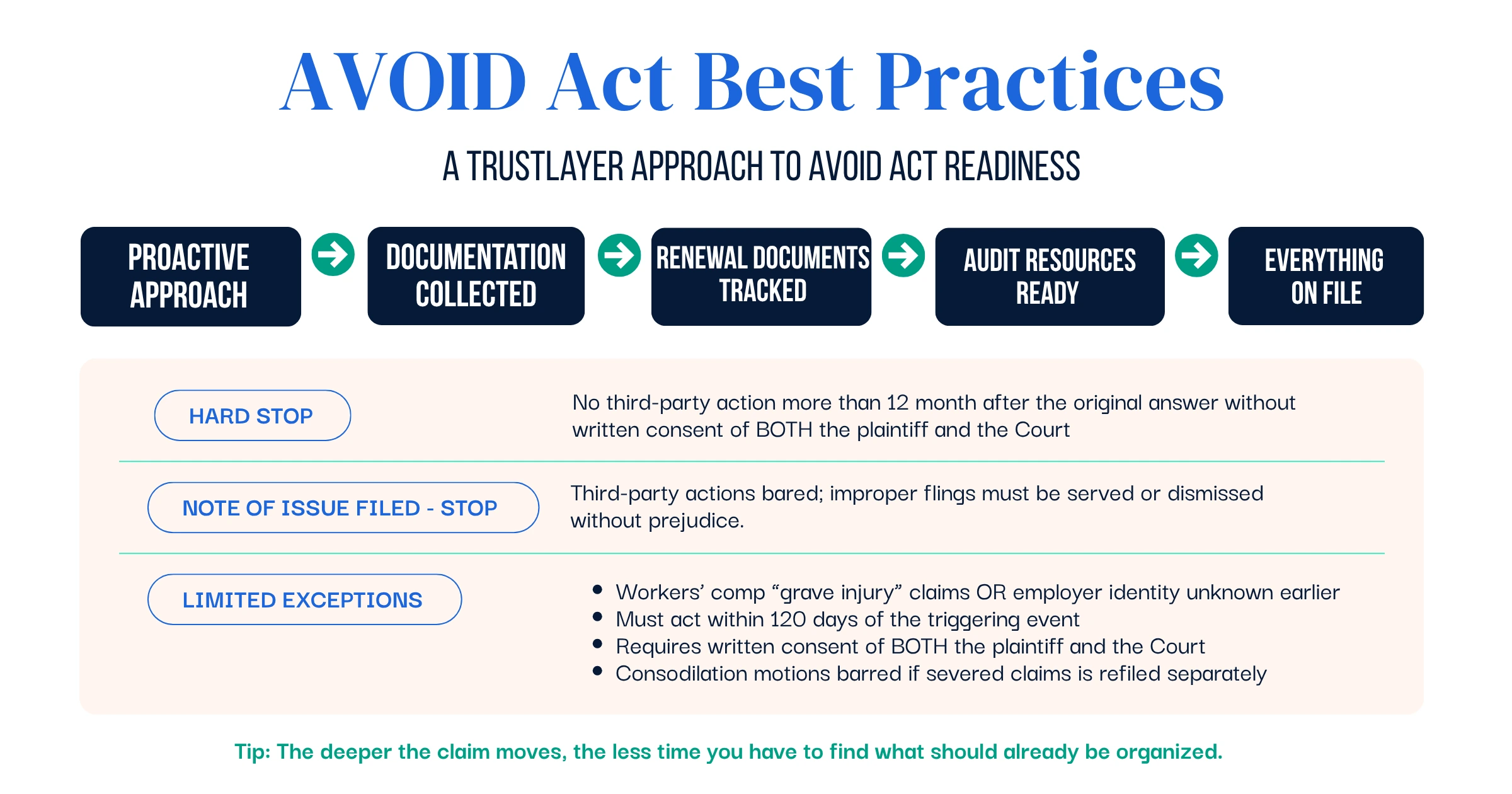
Avoid Act Best Practices
What Happens If You Miss the Deadline?
If you miss a third-party claim deadline under the AVOID Act, you may lose the ability to shift liability entirely—even if another party is actually responsible.
The contract may still exist.
The indemnity language may still say what it always said.
The insurance coverage may still be there.
But if you cannot surface and act on that information within the required timeframe, the result is the same:
You can be right and still lose.
Why the 90-Day Deadline Breaks Existing Workflows
There is one detail most teams overlook:
Waiting for insurance or tender responses does not pause the deadline.
Which means the standard workflow—review, request, wait—no longer protects you.
That workflow may still be common.
It may still feel reasonable.
But under the AVOID Act, common is not the same thing as safe.
The AVOID Act isn’t just a legal problem.
It’s a speed problem disguised as one.
Why the AVOID Act Changes Vendor Risk
The AVOID Act does not create new risk.
It exposes how slowly most teams manage the risk they already have.
Vendor risk has always lived at the intersection of:
- contracts
- insurance coverage
- documentation
- responsibility
The difference is timing.
These pieces used to be assembled after a claim.
Now they must be accessible before or immediately when one happens.
That changes everything.
Who the AVOID Act Impacts
- General contractors
- Subcontractors
- Insurance carriers
- Legal teams
- Risk and compliance managers
Any organization managing vendors, contracts, or insurance documentation is affected.
Why Most Teams Will Struggle to Meet the Deadline
Not because they lack documentation.
Because they cannot access it fast enough.
Contracts live in one system.
Insurance documents live in another.
Vendor records are scattered across spreadsheets, inboxes, and portals.
So when something happens, the process begins:
Search.
Request.
Wait.
Follow up.
Reconstruct.
That process used to be inefficient.
Now it is risky.
You Can Be Right and Still Lose
It’s worth repeating because it captures the real shift.
Even if your contract clearly assigns responsibility,
Even if insurance coverage exists,
Even if another party should be liable—
If you cannot act within the deadline:
You may still be responsible for the claim.
The AVOID Act doesn’t reward accuracy alone.
It rewards readiness.
How to Prepare for the AVOID Act
Prepared organizations don’t wait for a claim to organize.
They:
✔ Centralize vendor and contract data
✔ Connect insurance policies directly to agreements
✔ Improve visibility into compliance documentation
✔ Align legal, risk, and operations early
✔ Reduce delays in identifying responsible parties
This isn’t just better tracking.
It’s better readiness.
The Bigger Shift: From Reaction to Readiness
The AVOID Act signals something larger than a procedural change.
It marks a shift from:
“We’ll figure it out when something happens.”
To:
“We need to be ready before it does.”
That shift sounds simple—until you realize how many workflows still depend on time that no longer exists.
How TrustLayer Helps
TrustLayer gives teams immediate visibility into vendor contracts, insurance coverage, and compliance status—so they can identify liability and act within the 90-day deadline without chasing documents.
Instead of reconstructing responsibility after the fact, teams already know:
- Which vendors are involved
- What insurance documentation is on file
- How compliance connects to contractual requirements
- Where gaps may create exposure
That matters under any claims process.
But under the AVOID Act, it becomes critical.
Because speed is no longer optional.
For teams looking to improve vendor risk management, maintain cleaner documentation, and reduce exposure tied to insurance liability, TrustLayer supports the operational side of readiness.
You can also explore TrustLayer’s free COI tracking tool or get additional risk exposure visibility before taking the next step.
FAQ: AVOID Act Deadlines and Vendor Risk
Q: What is the AVOID Act in New York?
The AVOID Act is a New York law that imposes strict deadlines for filing third-party claims, requiring earlier identification of responsible parties in litigation.
Q: What happens if you miss a third-party claim deadline?
You may lose the ability to bring in other responsible parties, even if they are contractually liable.
Q: Does waiting for insurance responses pause the deadline?
No. Waiting for insurance or tender responses does not stop the deadline clock.
Q: Does the AVOID Act apply to existing cases?
Yes. In many cases, it applies to pending litigation where third-party claims have not yet been filed.
Q: Why does the AVOID Act matter for vendor risk management?
Because companies must identify responsible vendors and supporting documentation faster, putting pressure on contract access, insurance visibility, and compliance tracking.
Q: Who is most affected by the AVOID Act?
Industries with complex vendor relationships, including construction, real estate, insurance, and contractor-heavy operations.
Q: How can companies reduce risk under the AVOID Act?
By centralizing contract and insurance data, improving documentation access, and aligning teams to act earlier.
Get Ahead of the Deadline
Most teams won’t miss the deadline because they lack documentation. They’ll miss it because they can’t access it fast enough.
If your team is still searching for contracts when a claim happens, you are already behind.
👉 Get ahead of the deadline — schedule a demo
You might also like


.png)