Reduce Reopen Loops: The Fastest Way to Improve Time-to-Compliance
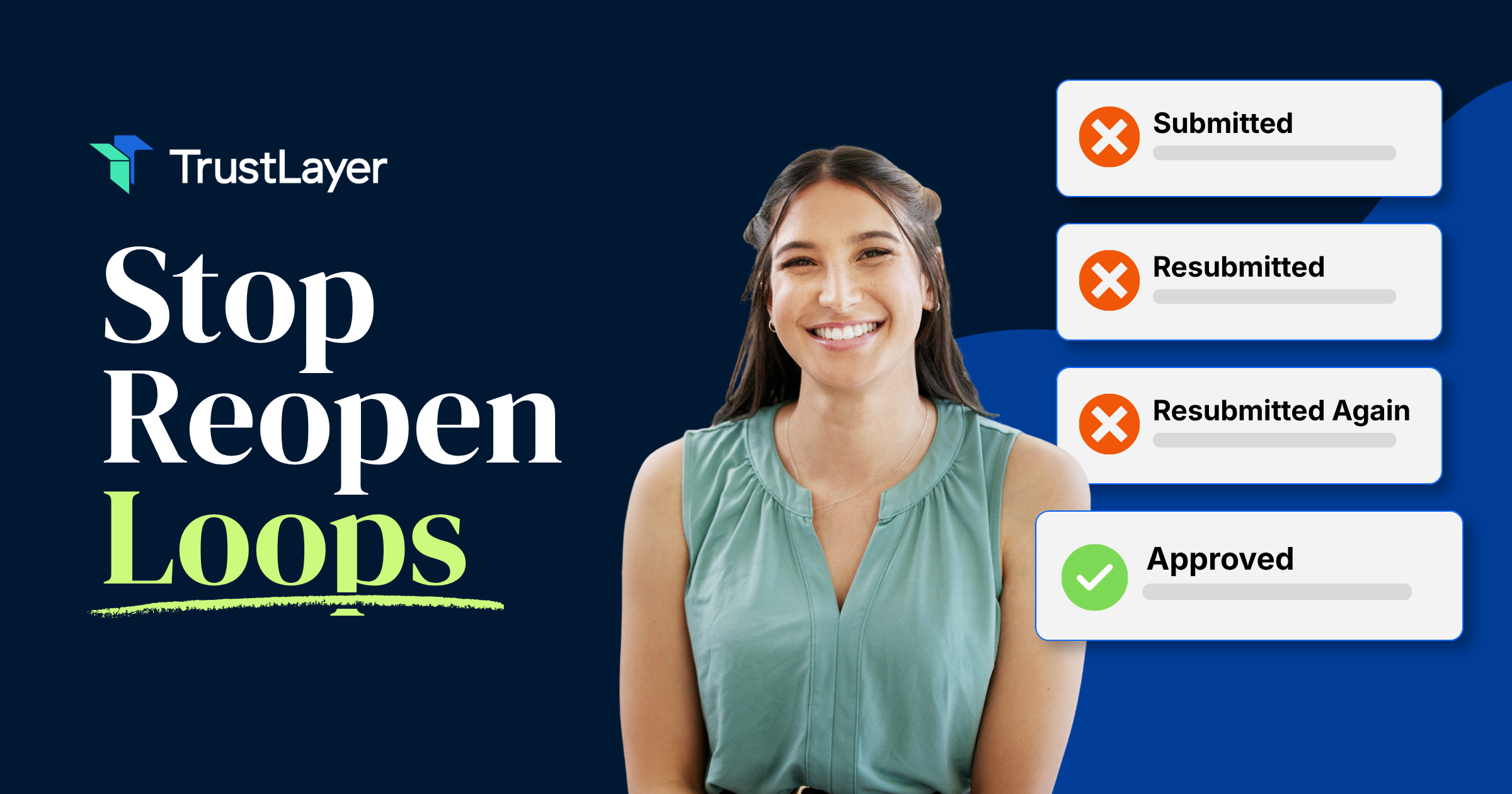
Every compliance team has experienced the same frustrating cycle: a document gets submitted, rejected for an issue, resubmitted with a different issue, rejected again, and so on until weeks have passed and nobody can remember why the process started in the first place. These reopen loops are one of the most underappreciated drains on compliance velocity, and they quietly inflate the time it takes to bring a vendor, contractor, or partner into full compliance. If you want to improve your time-to-compliant metric, the fastest lever you can pull is reducing how many times a document bounces back and forth before it's accepted. The fix isn't about working harder or hiring more people. It's about eliminating the conditions that cause rejections in the first place.
The Hidden Cost of Reopen Loops in Compliance Workflows
Most organizations track whether vendors are compliant. Fewer track how long it takes to get there, and almost none measure how many cycles a single document goes through before it's finally approved. That blind spot is expensive. A 2025 survey from the Risk Management Society found that the average COI goes through 2.3 review cycles before acceptance, and each cycle adds an average of four business days to the compliance timeline. Multiply that across hundreds or thousands of vendor relationships, and you're looking at thousands of wasted hours annually.
The real cost isn't just administrative time, though. Every day a vendor sits in a non-compliant state is a day your organization carries uninsured or underinsured risk—projects stall. Revenue-generating work gets delayed. And the compliance team gets blamed for being a bottleneck, when the actual problem is systemic.
Defining the Reopen Loop and Its Impact on Velocity
A reopen loop occurs any time a compliance document, most commonly a certificate of insurance, is submitted, reviewed, found deficient, sent back for correction, and resubmitted. Each round trip is one loop. A single deficiency caught and corrected is normal. Three or four loops on the same document signals a broken process.
The impact on velocity is straightforward: each loop resets the clock. If your target time-to-compliance is five business days but the average document requires two extra review cycles, you're realistically looking at 13 to 15 business days. That gap between expectation and reality creates friction with vendors, frustrates project managers, and erodes confidence in the compliance function. The loop itself becomes the bottleneck, not the review.
How Back-and-Forth Communication Inflates Time-to-Compliant
Think about what actually happens during a reopen loop. Your team identifies a problem, drafts a rejection notice, sends it to the vendor or their broker, waits for them to read it, waits for them to contact their insurance carrier, waits for the carrier to issue a corrected document, and then waits for the vendor to upload it. Each step adds delay, and none of it is under your control once the rejection is sent.
Communication is often the weakest link. Rejection notices that say "does not meet requirements" without specifying which requirement, or that reference the wrong policy number, or that list five issues when the reviewer only caught three on the first pass: all of these guarantee another loop. The vendor fixes the three items mentioned, resubmits, and gets rejected again for the two that weren't flagged initially. That's not the vendor's fault. That's a process failure on the compliance side.
Common Triggers for Insurance Document Rejections
Understanding why documents get rejected is the first step toward reducing reopen loops. While every organization has its own requirements, the same error categories show up repeatedly across industries. Most rejections fall into two buckets: data accuracy problems and coverage interpretation problems.
Inaccurate Data Entry and Manual Transcription Errors
This is the most common and most preventable category. A vendor's name is misspelled. The certificate holder's address doesn't match what's on file. The policy number has a transposed digit. The effective dates are wrong. These aren't coverage issues: they're clerical mistakes that happen when humans manually transfer information between systems.
The problem compounds when you consider the chain of custody for a typical COI. The vendor requests it from their broker. The broker requests it from the carrier. The carrier generates it, sometimes through an automated system, sometimes through a human. The broker sends it to the vendor. The vendor uploads it. At every handoff, there's an opportunity for a typo, an outdated address, or a wrong entity name. And because most compliance teams review these documents manually, those errors often go unnoticed until someone sits down to review the certificate, which may be days after submission.
Misinterpretation of Complex Policy Endorsements
This is the trickier category. Insurance requirements aren't always straightforward, especially for organizations that require additional insured status, waiver-of-subrogation endorsements, or specific coverage sublimits. Vendors and their brokers frequently misunderstand what's being asked for, and compliance reviewers sometimes disagree about whether a given endorsement satisfies the requirement.
Consider a common scenario: your organization requires "additional insured" status on a vendor's general liability policy. The vendor's broker adds a blanket additional insured endorsement, which covers any entity the vendor is contractually obligated to name. Your reviewer rejects it because the endorsement doesn't specifically list your company's name. Is the rejection correct? It depends on your organization's standards, but the ambiguity creates the loop. The vendor's broker pushes back, your reviewer escalates, and days pass while people argue about endorsement language.
Strategies to Bridge the Gap Between Submission and Approval
Reducing the distance between initial submission and final approval requires changes on both sides of the transaction: clearer expectations for vendors and better tools for reviewers. Neither alone is sufficient.
Standardizing Requirements for Vendors and Partners
One of the most effective things you can do is give vendors a crystal-clear picture of what you need before they submit anything. That sounds obvious, but most organizations fail at it. Requirements are buried in contract language vendors don't read, communicated verbally and never documented, or vary by department with no central standard.
A strong requirements package includes:
- Exact minimum coverage limits for each line of insurance (GL, auto, workers' comp, umbrella)
- Specific endorsement requirements with example language or ISO form numbers
- The precise certificate holder name and address to use
- Any naming conventions or reference numbers that must appear on the certificate
- A checklist format that vendors can hand directly to their broker
When vendors know exactly what's expected, their brokers can get it right the first time. This single change, providing unambiguous requirements upfront, can cut reopen loops by 40% or more based on what organizations that have implemented it report.
Leveraging Automated Verification to Catch Errors Early
Manual review is slow, inconsistent, and prone to the same human errors it's trying to catch. If your compliance team is reading every certificate line by line and comparing it against a spreadsheet of requirements, you're guaranteeing delays and missed issues.
Automated verification tools can check a submitted document against your requirements in seconds, flagging specific deficiencies before a human reviewer ever touches it. The key advantage isn't just speed: it's completeness. An automated system catches all five issues on the first pass, not three. That means the vendor gets one comprehensive rejection notice instead of a drip feed of problems across multiple cycles.
The distinction matters because the goal isn't to eliminate human judgment from compliance review. Complex endorsement questions still need experienced eyes. But there's no reason a human should be checking whether a policy expiration date is in the future or whether the general liability limit meets a $1 million minimum. Those are binary checks that software handles perfectly.
Accelerating Time-to-Compliance Through Real-Time Feedback
The traditional compliance workflow is asynchronous by default. A vendor submits a document. Days later, someone reviews it. Days after that, the vendor gets a rejection notice. Days after that, a corrected document arrives. Each step introduces dead time where nothing is happening except waiting.
Real-time feedback compresses this timeline dramatically. When a vendor uploads a document and immediately sees which requirements are met and which aren't, they can address issues before they even leave the upload session. No waiting for a reviewer. No email chain. No phone tag with their broker about which endorsement was missing.
This shift from "submit and wait" to "submit and know" changes the psychology of the process, too. Vendors stop viewing compliance as an adversarial gatekeeping exercise and start treating it as a checklist they can work through. That cooperation alone accelerates time-to-compliant because vendors who understand the process are far more likely to get it right quickly.
Reducing Friction with Self-Service Document Uploads
The upload experience itself matters more than most compliance teams realize. If a vendor has to email a PDF to a generic inbox, they have no visibility into what happens next. They don't know if the document was received, who's reviewing it, or when they'll hear back. That uncertainty leads to duplicate submissions, follow-up emails, and phone calls that consume everyone's time.
A self-service portal where vendors can upload documents, see requirements in plain language, track submission status, and receive specific feedback on deficiencies removes most of that friction. It also creates an audit trail that protects both parties. The vendor can prove they submitted on time. The compliance team can prove they communicated requirements clearly.
The best implementations let vendors see exactly what's needed before they upload, so they can verify their document meets requirements without submitting it for review first. Think of it like a tax filing system that checks your math before you hit "submit" rather than sending you a rejection letter six weeks later.
Measuring Success: KPIs for Compliance Efficiency
You can't reduce reopen loops if you aren't measuring them. Most compliance teams track binary compliance status: a vendor is either compliant or not. That's necessary but insufficient. To actually improve your process, you need metrics that capture the journey, not just the destination.
The KPIs that matter most for reducing reopen loops and improving time-to-compliant:
- Average loops per document: How many review cycles does a typical COI go through before approval? Track this over time to see if process changes are working.
- Time-to-compliant: Measured from initial document request to final approval. Break this down by vendor category, document type, and reviewer to identify patterns.
- First-pass acceptance rate: What percentage of submitted documents are approved without any rejection? This is your clearest indicator of requirement clarity.
- Rejection reason distribution: Categorize every rejection by type (data error, coverage gap, endorsement issue, wrong form). The categories that appear most frequently are your biggest opportunities.
- Vendor response time: How long does it take vendors to resubmit after a rejection? If this number is high, your rejection notices may not be clear enough.
Track these monthly and share them with your team. When people can see that incorrect certificate holder names cause 60% of rejections, the solution becomes obvious: fix the way you communicate that requirement. Data turns a vague sense that "compliance takes too long" into specific, fixable problems.
Optimize Your Compliance Lifecycle with TrustLayer
The pattern is clear: reopen loops are the single biggest driver of slow time-to-compliant, and they're almost entirely preventable. Clear requirements, complete first-pass reviews, real-time feedback, and self-service tools for vendors can cut your compliance timeline from weeks to days. The organizations that have made this shift aren't just faster: they carry less uninsured risk, maintain better vendor relationships, and free their compliance teams to focus on judgment calls instead of data entry.
If your team is still chasing vendors through email threads and manually comparing certificates against spreadsheets, the math on that approach only gets worse as your vendor base grows. TrustLayer was built specifically for this problem, helping risk managers automate the collection, tracking, and verification of certificates of insurance so that the reopen loop becomes the exception rather than the rule. If you're ready to move from reactive compliance firefighting to a continuous, sustainable process, set up a time to talk with our team and see what a modern approach looks like.
For more on building a compliance program that actually works, check out other articles on the TrustLayer blog covering everything from COI tracking best practices to vendor risk management strategies.
You might also like