ITC Vegas 2026 | Complete Attendee Playbook
ITC Vegas is enormous.
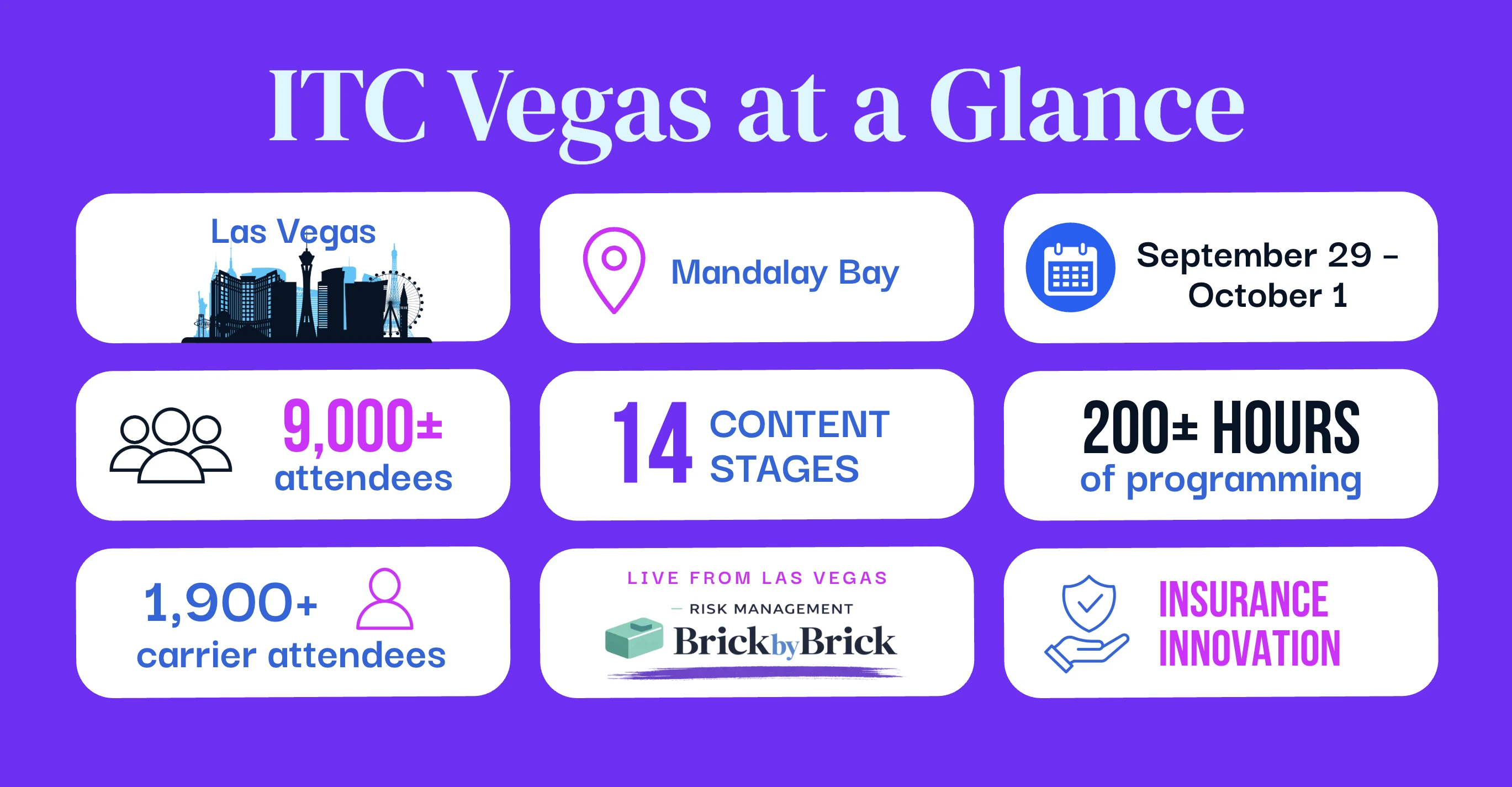
Not “there are a lot of breakout sessions” enormous. More like 9,000+ insurance professionals, 500+ speakers across 14 content stages, 200+ hours of programming, hundreds of exhibitors, and enough simultaneous activity to make you question every decision you made before breakfast enormous.
Which means the challenge is not finding something to do.
The challenge is figuring out what is actually worth your time.
ITC brings carriers, reinsurers, agents, brokers, MGAs, insurtech founders, investors, technology companies, regulators, associations, educators, and media into one sprawling insurance ecosystem at Mandalay Bay Resort and Casino. The official conference runs September 29 through October 1, but the broader week begins with pre-conference events and continues through Thursday night’s closing party.
TrustLayer plans to be on-site through the press and media side of the event, with access being pursued for members of our team through Risk Management: Brick by Brick, our podcast built around candid conversations with the people reshaping risk, insurance, technology, and business.
We do not currently expect to have a booth.
That is probably useful information.
You will not need to wander past several hundred displays looking for us. Instead, our team will be moving through the event, talking with industry leaders, watching which ideas are moving from conference language into actual operations, and looking for the conversations worth bringing back to the risk management community.
This guide is designed to help you do the same.
Quick Answers
What is ITC Vegas?
ITC Vegas is a global insurance and insurtech conference that brings together carriers, brokers, independent agents, MGAs, startups, technology providers, investors, regulators, associations, educators, and media.
When is ITC Vegas 2026?
The formal conference takes place September 29–October 1, 2026. ITC recommends arriving September 28 and leaving October 2 if you want to participate in the wider event week and Thursday night’s closing party.
Where is ITC Vegas 2026?
The event is held at Mandalay Bay Resort and Casino in Las Vegas, Nevada.
How many people attend ITC Vegas?
Organizers expect more than 9,000 industry participants, including approximately 1,900 carrier attendees.
Will TrustLayer have a booth?
TrustLayer does not currently expect to exhibit.
What topics does the agenda cover?
The ITC Vegas 2026 agenda includes artificial intelligence, underwriting, pricing, claims, fraud, commercial and specialty lines, cybersecurity, distribution, embedded insurance, parametric insurance, life and health, benefits, investment, and insurance operations.
Why ITC Vegas 2026 Matters
Insurance conferences tend to fall into one of two categories.
There are events where nearly everyone already knows one another. Those can be valuable, but they can also become predictable.
Then there are events where almost every corner of the industry appears at once, creating possibility and logistical chaos in roughly equal measure.
ITC Vegas is the second kind.
Carriers arrive looking for ways to modernize operations. Brokers and agents evaluate technologies, markets, and distribution strategies. Insurtech companies try to demonstrate that they are more than an attractive demo. Investors look for the next thing. Technology vendors explain why this year’s AI announcement is different from last year’s AI announcement.
Somewhere inside all of that noise are ideas that will materially change how insurance work gets done.
ITC matters because it provides a concentrated view of what the insurance industry thinks is important right now—and, just as importantly, what everyone is still struggling to solve.
Do Not Try to “Do ITC”
You cannot do all of ITC Vegas.
You cannot attend 14 stages.
You cannot have meaningful conversations with 9,000 people.
You cannot properly evaluate hundreds of exhibitors while also attending every keynote, summit, meetup, happy hour, podcast, party, demonstration, and whatever happens after somebody says, “There’s another thing at the hotel next door.”
Trying to do everything is the quickest way to return home with sore feet, 47 photographs of slides you will never revisit, and no clear answer to what the conference was actually about.
Before you arrive, choose one primary question.
Not ten.
One.
For example:
- Where is AI genuinely improving insurance workflows?
- How are carriers governing automated decisions?
- Which distribution technologies are producing measurable results?
- How are brokers becoming more valuable to clients?
- What does operational modernization look like beyond a product demo?
- How are insurance organizations verifying increasingly complex third-party data?
- Which startups are solving painful problems instead of decorating them?
Use that question as your filter.
Every session, exhibit, meeting, interview, and coffee conversation becomes more useful when you know what you are trying to understand.
How the ITC Vegas 2026 Agenda Works
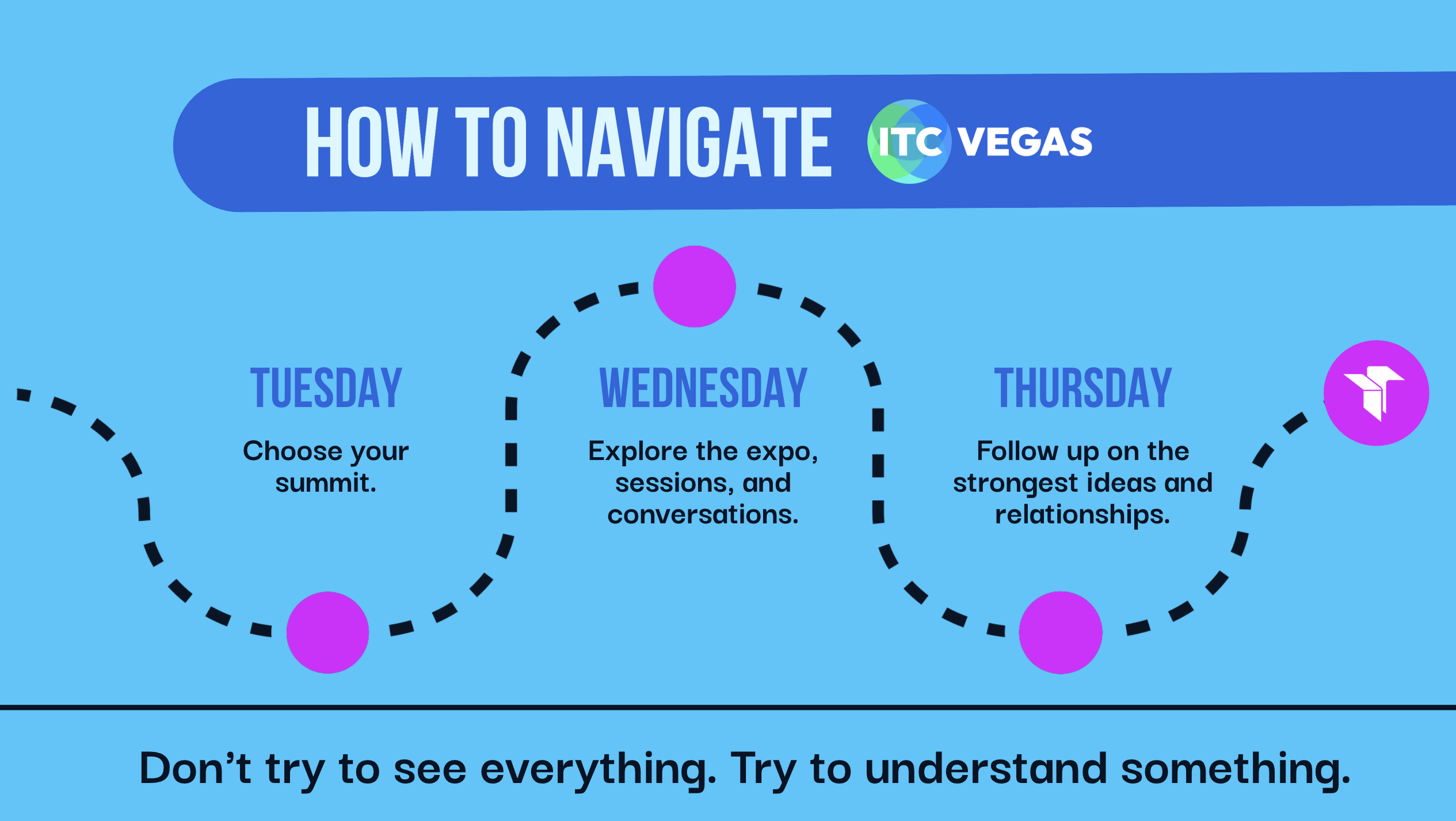
The official agenda is still being updated, and individual session times may change before the event. The basic structure is already clear: Tuesday is organized around focused summits, while Wednesday and Thursday open the larger stages and expo experience.
Tuesday, September 29: Choose Your Lane
Tuesday is the day to go deep.
Rather than moving constantly between unrelated topics, attendees can spend a half or full day inside a particular issue.
Current summit areas include:
- AI-powered insurance innovation
- Claims transformation and fraud
- Commercial and specialty lines
- Health innovation
- The modern underwriter
- Independent agents
- ITC LATAM
- Strategy and corporate development
- Agentic insurance
- Operationalizing AI
The temptation will be to select the session with the loudest title.
Resist it.
Choose the summit closest to the problem you are actually responsible for solving.
The AI-Powered Insurance Innovation Summit
The AI conversation at ITC is moving beyond basic chatbots and content generation.
The stronger sessions focus on systems that can execute portions of quoting, triage, documentation, servicing, underwriting, and decision-making inside governed workflows. The agenda also addresses orchestration, permissions, accountability, cost control, model performance, auditability, data quality, and human oversight.
That distinction matters.
AI is easy to demonstrate in a controlled environment. It is much harder to place inside a regulated organization with fragmented data, complex approvals, legacy systems, and real consequences when the answer is wrong.
When evaluating AI at ITC, ask:
- What specific workflow is being improved?
- What information does the system depend on?
- How is the output verified?
- Where does a human remain accountable?
- Can the decision be explained later?
- What happens when the source document is incomplete or fraudulent?
- Does this system improve operations, or simply create another layer of software?
TrustLayer faces a version of this problem every day. Collecting documents is only the beginning. The harder work is turning scattered information into a reliable, visible compliance process. Our certificate of insurance tracking platform combines automated collection, expiration tracking, alerts, and document history so teams can spend less time searching for files and more time acting on what those files actually mean.
Claims Transformation and Fraud
Claims is becoming one of the clearest testing grounds for AI.
The agenda covers automated intake, triage, structured claims files, fraud detection, digital verification, governance, customer trust, and the uncomfortable reality that generative AI now makes convincing fake documents, photographs, voices, and identities easier to produce.
The interesting question is not whether automation can make claims faster.
It can.
The question is how insurers become faster without making themselves easier to deceive.
That same tension exists across insurance compliance. A certificate may look complete while still failing to prove that the underlying coverage meets the requirement. A document may be current but incomplete. A name may match while the endorsement language does not.
For a practical look at the difference between simply gathering documents and building stronger compliance relationships, read From Collection to Connection. It explains why collecting a COI does not automatically establish that coverage is adequate, current, or valid.
Commercial and Specialty Lines
Commercial insurance still contains an extraordinary amount of manual work:
Applications. Supplemental forms. Schedules. Loss runs. Policy documents. Emails. Spreadsheets. Attachments that rarely arrive in the same format twice.
The commercial and specialty programming explores API-based placement, structured submissions, document intelligence, AI-assisted underwriting, parametric insurance, and the infrastructure required to move business from submission to bind without losing judgment along the way.
This has a direct connection to the wider compliance problem.
Automation works only when the underlying information can be collected, structured, verified, and traced.
That is as true for an underwriting submission as it is for an insurance certificate, endorsement, license, or W-9.
Organizations building connected insurance workflows can also explore the TrustLayer API platform, which helps teams aggregate, manage, and move compliance data through their existing systems instead of creating another disconnected source of truth.
ITC Agents
Independent agents receive a dedicated program focused on AI use cases, talent, recruitment, niche specialization, operational efficiency, and building agencies that remain human without remaining manual.
That last distinction is worth holding onto.
The future of an agency is probably not fewer relationships.
It is fewer repetitive tasks masquerading as relationship work.
Chasing certificates, searching shared inboxes, copying expiration dates into spreadsheets, and sending the same follow-up email for the fifth time are not the human part of insurance.
They are administrative residue.
For smaller agencies or clients beginning to modernize that work, TrustLayer Starter offers free COI tracking, expiration monitoring, automated vendor notifications, a centralized compliance dashboard, and AI-assisted capabilities.
Tuesday Afternoon: Go to the First-Timers Orientation
ITC offers a first-timers orientation Tuesday afternoon.
Go.
This is not an admission of weakness.
It is an acknowledgment that Mandalay Bay is large, the schedule is dense, and there is no award for becoming lost before your first useful conversation.
The orientation also gives new attendees a natural place to meet other people who have not yet disappeared into established conference groups. The current agenda lists the orientation from 2:00 to 3:00 p.m. on Tuesday.
Tuesday Evening: The Official Kickoff Party
The official kickoff party runs Tuesday evening and is built around music, food, drinks, and networking.
Use it to continue conversations you have already started.
Do not spend two hours introducing yourself from scratch to 30 people.
The person you met at 11:00 a.m. and encounter again at 5:30 p.m. is more likely to become a real contact than the person whose badge you scanned while both of you were already looking over the other’s shoulder.
Wednesday, September 30: The Full Machine Turns On
Wednesday is when the scale of ITC becomes impossible to ignore.
Main-stage keynotes begin in the morning. The expo floor opens. Multiple content stages run simultaneously. Community meetups, AI programming, growth discussions, operational-efficiency sessions, strategic-foresight tracks, and life, health, and benefits content continue throughout the day.
This is where your one-question strategy becomes essential.
Choose:
- One major session you genuinely care about
- Two or three organizations you want to meet
- One community gathering
- One block of unscheduled time
That empty block matters.
ITC is full of people who will ask whether you have “five minutes” and then either change your week or consume the next 47 minutes discussing a platform you will never buy.
Leave enough space for the first kind.
Thursday, October 1: Follow the Threads
By Thursday, you will have heard the same phrases repeatedly.
Agentic AI.
Operational transformation.
Connected ecosystems.
Embedded decisioning.
Real-time data.
Human-centered automation.
Do not collect more phrases.
Follow the threads.
Return to the people who gave you a useful answer on Tuesday or Wednesday. Ask what they have implemented. Ask what broke. Ask what required more organizational change than expected. Ask whether the result survived contact with actual users.
Thursday is also the day for cyber innovation, AI programming, community meetups, solution demonstrations, and the final full expo-floor experience.
Where the Real Conversations Happen
The stages matter.
They are not the only places where ITC happens.
The 1:1 Meeting Zone
The expo-floor Meeting Zone provides dedicated tables that attendees can reserve through the ITC Vegas mobile app. An additional Tuesday meeting zone is planned for the second floor.
Use it.
A scheduled 20-minute conversation with the correct person can be worth more than an entire afternoon of accidental booth wandering.
But do not schedule every available minute.
A conference itinerary that looks like an air-traffic-control screen guarantees that one late conversation will ruin the next four.
Community Meetups
ITC’s community programming includes gatherings for first-time attendees, Black leaders, women in insurance, founders, executives, and other focused communities.
These gatherings are useful because they make a giant event smaller.
A 9,000-person conference is not a community.
A room of 40 people with a shared question can become one.
Coffee Lounges and the Biergarten
The expo floor includes coffee lounges, casual networking spaces, happy hours, a biergarten, and other areas designed to make conversations happen without requiring a formal meeting invitation.
Use these spaces to slow the day down.
The goal is not to mention your company as quickly as possible.
The goal is to hear a sentence you would not have heard while standing in a demonstration line.
The Puppy Parks
Yes, there are puppy parks.
This sounds like a gimmick because it is a gimmick.
It is also difficult to maintain a rigid corporate persona while sitting next to an insurance executive holding a sleepy puppy.
Use that information however you see fit.
Content Creation at ITC Vegas
ITC has built a significant media and content infrastructure into the event.
The expo includes Live @ ITC for announcements and industry news, a Podcast Lounge with private recording studios, and a Content Studio equipped with branded backdrops, lighting, and lounge furniture for interviews. Podcast Lounge reservations are available on-site to approved press and media attendees, with attendees expected to bring their own recording equipment.
That makes the event a natural fit for Risk Management: Brick by Brick.
The podcast is not built around polished statements about “innovation.”
It is built around the details underneath them:
- What changed?
- What failed?
- What did the team underestimate?
- Where does risk actually sit?
- What does the work look like after the announcement?
- How do leaders get an organization to behave differently?
TrustLayer is pursuing press passes for members of our team, but recording plans have not yet been confirmed. We will update this guide once access and any on-site podcast activity are finalized.
The AI Question Hanging Over Everything
AI will be everywhere at ITC Vegas.
That does not mean every AI conversation will be useful.
A practical way to evaluate what you hear is to separate three ideas that are often blended together:
Assistance
The system helps a person complete work faster.
Examples include summarization, document extraction, recommendations, drafting, and workflow guidance.
Automation
The system performs a defined process with limited human intervention.
Examples include intake, routing, reminders, validation checks, and routine servicing.
Decision authority
The system makes or materially shapes decisions involving pricing, eligibility, claims, underwriting, risk, or coverage.
These are not the same thing.
They do not carry the same operational, ethical, regulatory, or reputational stakes.
A tool that summarizes a submission is different from a system that declines it. A tool that flags a document for review is different from one that decides the document proves compliance.
The most useful AI discussions at ITC will be the ones that state clearly which category they occupy.
What Different Attendees Should Prioritize
Carriers and Reinsurers
Focus on:
- AI governance
- Claims and fraud
- Underwriting infrastructure
- Data quality
- Distribution connectivity
- Cyber and emerging risks
- Operational implementation
Ask vendors where their system sits inside the carrier’s actual workflow, not just what it can display in a demonstration.
Independent Agents and Brokers
Focus on:
- Client-service efficiency
- Distribution technology
- Renewal workflows
- Data and document handling
- AI that supports rather than replaces producers
- New advisory and service opportunities
The most useful technology will remove administrative friction without making the client feel processed.
Insurtech Founders
Focus on:
- Whether buyers understand the problem immediately
- Implementation burden
- Integration requirements
- Proof of measurable outcomes
- Governance
- Whether the product survives outside a pilot
A compelling demo is not the same as a durable operating system.
Risk and Compliance Leaders
Focus on:
- Verification
- Auditability
- Data lineage
- Human oversight
- Third-party risk
- Workflow ownership
- Evidence that can be produced after something goes wrong
Teams evaluating insurance compliance platforms can compare the difference between basic tracking and more comprehensive managed solutions in TrustLayer’s guide to the best managed insurance compliance platforms for 2026.
Press and Media
Focus on the gap between what companies announce and what customers can actually use.
The useful story is rarely “Company launches AI product.”
The useful story is:
- What work changes?
- Who remains accountable?
- Who buys it?
- What data does it require?
- What happens when it is wrong?
- What did the company have to rebuild to make it work?
Where to Stay for ITC Vegas 2026
ITC’s official travel guidance lists Mandalay Bay as the primary venue. As of the organizer’s July 8 update, the Mandalay Bay and W Las Vegas room blocks were sold out. The organizer identifies Connections Housing as the only official housing provider and warns attendees against unauthorized booking companies presenting themselves as affiliated with the event.
Luxor Hotel & Casino
Luxor Hotel & Casino is the simplest official alternative because it connects to Mandalay Bay through an indoor walkway and is roughly five minutes away on foot.
That proximity matters more than it sounds.
ITC days are long. Returning to a room without needing a rideshare, casino navigation strategy, or small diplomatic mission is worth something.
Other Official Housing Options
ITC previously identified New York-New York and MGM Grand alongside Luxor as partner hotel options, although availability and rates may change as the event approaches. Use the official ITC travel page rather than booking through unsolicited housing vendors.
Getting to Mandalay Bay
Most attendees will fly into Harry Reid International Airport.
Mandalay Bay sits at the south end of the Las Vegas Strip at 3950 South Las Vegas Boulevard. ITC’s official travel guidance includes air and driving information, and the venue is generally a short ride from the airport depending on traffic and event congestion.
Build extra time into your arrival.
Las Vegas has a special ability to make two buildings that appear adjacent require 23 minutes of walking, two escalators, a retail corridor, and a brief period of self-reflection.
Three Places to Eat Without Turning This Into a Las Vegas Restaurant Guide
ITC already gives attendees more choices than they can reasonably process. You do not need another list of 19 restaurants.
These three options keep you close to the venue.
Caramá
Caramá serves Italian food inside Mandalay Bay and works well for a more polished partner or client dinner without leaving the property.
Kumi Japanese Restaurant and Bar
Kumi is another on-property option, combining Japanese and East Asian influences in a setting suited to a smaller business dinner.
Mandalay Bay Food Court
The Mandalay Bay Food Court sits near the convention center and Shark Reef Aquarium. It is not where you take the most important prospect of your career. It is where you get food quickly before realizing your next session begins in nine minutes.
Things to Do Near ITC Vegas
You do not need to cross the entire Strip to escape the conference for an hour.
Shark Reef Aquarium
The Shark Reef Aquarium is located at Mandalay Bay and is open daily, making it a manageable option when you need a break from stages, screens, and people explaining agentic workflows.
Mandalay Bay Beach
The resort’s amenities and attractions include Mandalay Bay Beach, pools, nightlife, bars, shops, and spa services. Availability can vary by season, so check current hours before building your recovery strategy around a pool chair.
The Shoppes at Mandalay Place
The Shoppes at Mandalay Place connects Mandalay Bay and Luxor and includes restaurants, bars, lounges, and shops. It is also a useful indoor route when Las Vegas remembers it is located in a desert.
Thursday Night: The Closing Party
The official closing party takes place Thursday, October 1, and features the Gin Blossoms. Access is limited to ITC Vegas badge holders.
Go, especially if you are leaving Friday.
Not because a closing party will unlock the central mystery of insurance innovation.
Because after three days of scheduled interactions, people occasionally begin speaking like actual people.
That is generally useful.
How to Turn ITC Vegas Into Something Useful
Within 48 hours of returning home:
- Write down the three ideas you still remember without opening your notes.
- Identify the two people whose answers changed your thinking.
- Delete the 11 vendor follow-ups you agreed to only because you were tired.
- Schedule the conversations that deserve another hour.
- Choose one workflow, technology question, or operating assumption to test.
- Share a short internal recap focused on decisions—not session summaries.
A conference should change something.
It does not have to transform the company.
It should at least change the next question.
Frequently Asked Questions: ITC Vegas 2026
Q: What is ITC Vegas?
ITC Vegas is a global insurance innovation conference that brings together insurers, reinsurers, brokers, agents, MGAs, startups, technology providers, investors, regulators, associations, educators, and media.
Q: When is ITC Vegas 2026?
The formal event runs from Tuesday, September 29, through Thursday, October 1, 2026. Broader ITC week activities begin earlier, and attendees are encouraged to leave Friday morning if they plan to attend Thursday night’s closing event.
Q: Where is ITC Vegas held?
ITC Vegas 2026 is held at Mandalay Bay Resort and Casino in Las Vegas.
Q: Who attends ITC Vegas?
Attendees include carriers, reinsurers, agents, brokers, MGAs, insurtechs, startups, solution providers, investors, regulators, associations, educators, and members of the press.
Q: How large is ITC Vegas?
The event expects more than 9,000 participants, 500+ speakers across 14 content stages, approximately 1,900 carrier attendees, and more than 200 hours of programming.
Q: What are the biggest topics at ITC Vegas 2026?
Major themes include generative and agentic AI, underwriting, claims, fraud, cybersecurity, commercial and specialty lines, insurance distribution, embedded insurance, parametric insurance, life and health, benefits, and investment.
Q: Is ITC Vegas useful for independent agents?
Yes. ITC Agents provides dedicated programming focused on AI, agency growth, operational efficiency, recruitment, niche strategy, and maintaining a human-centered agency.
Q: Is there an expo floor?
Yes. The ITC Vegas expo includes hundreds of solution providers, meeting areas, stages, startup kiosks, content studios, community spaces, lounges, and interactive experiences.
Q: How should first-time attendees prepare?
Choose one primary question before arriving, attend the First-Timers Orientation, reserve important meetings early, leave unscheduled time, wear comfortable shoes, and avoid trying to attend every available session.
Q: Will TrustLayer have a booth?
TrustLayer does not currently expect to have a booth.
Q: Where should attendees stay?
Mandalay Bay and W Las Vegas were listed as sold out in the official ITC block as of July 8. Luxor is an official nearby alternative connected to Mandalay Bay by an indoor walkway. Attendees should use the official ITC housing information and avoid unauthorized housing vendors.
Q: What airport serves ITC Vegas?
Harry Reid International Airport is the primary commercial airport serving Las Vegas.
Q: What should attendees wear?
Business casual is appropriate for most sessions and meetings. Comfortable shoes are not optional unless you have discovered a new and exciting relationship with foot pain.
Make Your ITC Vegas 2026 Trip Count
You are not going to see everything.
Good.
That is not the assignment.
Choose the question that brought you to Las Vegas.
Find the people who have actually worked on it.
Listen for the difference between a demonstration and a deployment.
Ask what broke.
Ask who owns the result.
Ask how the decision is verified six months later.
Then leave Mandalay Bay with fewer vague impressions and a clearer idea of what deserves your attention next.
Until then, explore the TrustLayer Resource Center for more practical conversations and guidance on insurance compliance, certificate tracking, vendor risk, and the systems behind modern risk management.
When you are ready to see how automated insurance compliance works inside your organization, schedule time with TrustLayer.
You might also like