Compliance Escalations: Automation, Routing, and Decisions That Scale
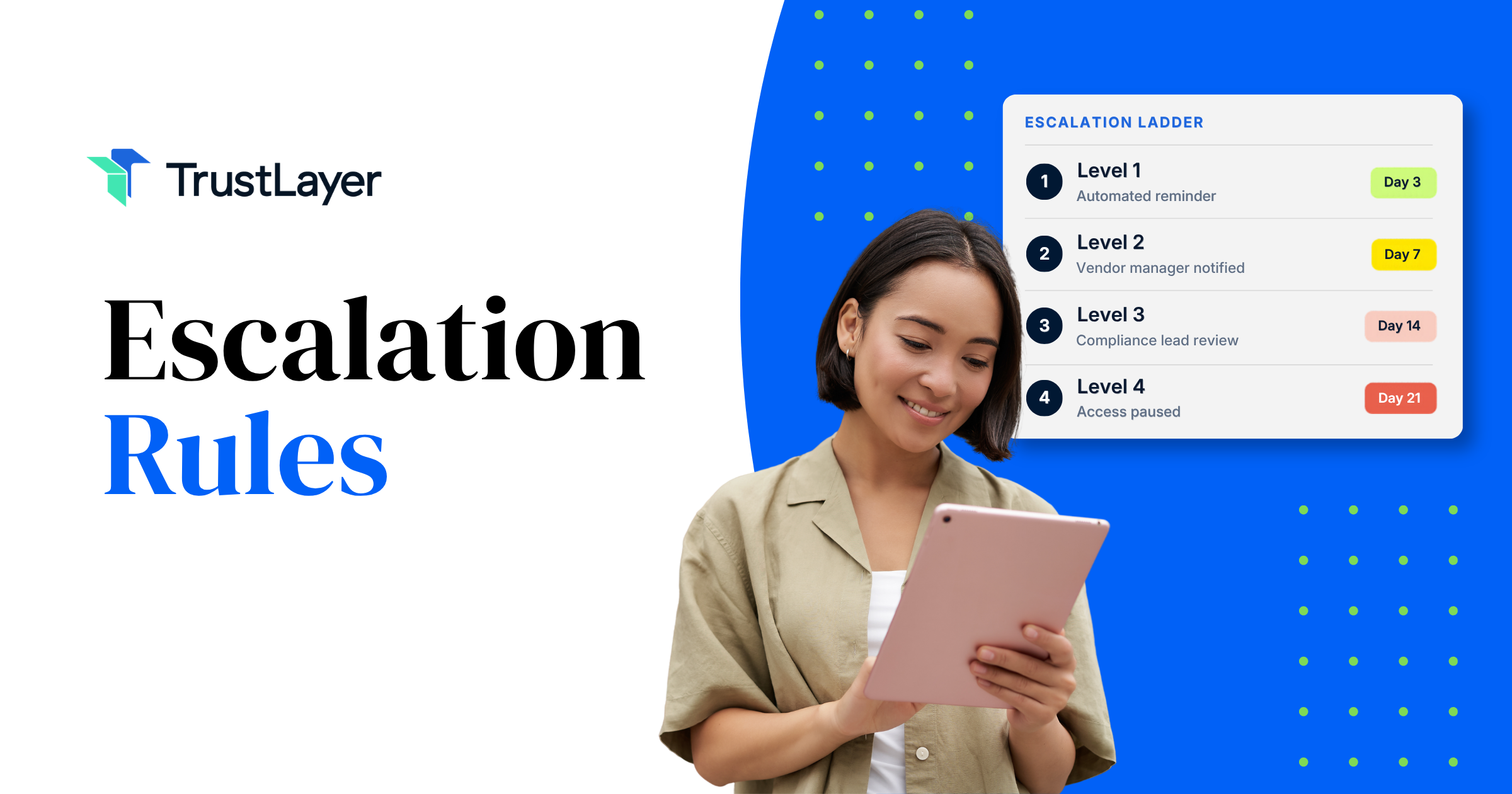
Every compliance team has a breaking point. Maybe it's the third time this quarter that an expired certificate of insurance slipped through the cracks and nobody caught it until a claim landed on someone's desk. Maybe it's the realization that your "system" for tracking vendor coverage is actually just Karen in accounting and a color-coded spreadsheet she built in 2019. The uncomfortable truth is that most organizations don't have a real process for handling compliance escalations: they have a patchwork of habits, tribal knowledge, and good intentions that works fine until it doesn't. And when it doesn't, the consequences are measured in dollars, legal exposure, and lost sleep. Building a framework where escalation decisions are automated, routed intelligently, and defensible at scale isn't just an operational upgrade. It's the difference between managing risk and just hoping for the best.
The Anatomy of a Modern Compliance Escalation Framework
A compliance escalation framework is the decision tree that determines what happens when something goes wrong or looks like it's about to. In insurance verification, "wrong" can mean a lot of things: a vendor's COI is expired, a subcontractor's coverage limits fall short of contract requirements, an endorsement is missing, or a policy was cancelled mid-project and nobody was notified. The framework defines which of these situations can be resolved automatically, which need a human review, and which need to be flagged to senior risk leadership immediately.
The best frameworks share a common trait: they treat escalation as a spectrum, not a binary. Not every issue demands the same urgency. An auto-renewal that's three days late is a different animal than discovering your largest subcontractor has been operating without adequate liability coverage for six months.
Defining High-Risk Triggers in Insurance Verification
High-risk triggers are the specific conditions that should automatically kick an issue up the chain. These aren't vague guidelines like "anything that looks concerning." They're precise, measurable criteria.
- A vendor's general liability coverage drops below the contractually required minimum (e.g., $2M per occurrence)
- A certificate of insurance expires with no replacement received within a defined grace period
- A required endorsement, such as additional insured status, is absent from a newly submitted COI
- A policy cancellation notice is received mid-contract
- A vendor operates in a high-risk category (demolition, hazardous materials, heavy construction) and any coverage gap is detected
Without clearly defined triggers, your team ends up making judgment calls on the fly. That's how inconsistencies creep in, and inconsistency is the enemy of defensible compliance.
Moving Beyond Manual Triage and Spreadsheets
Here's the problem with spreadsheets: they don't send alerts. They don't route issues to the right person. They don't create audit trails. They're static records in a world that demands dynamic responses. A 2024 Deloitte survey on third-party risk management found that 65% of organizations still rely on manual processes for significant portions of their compliance workflows. That number has likely improved somewhat by 2026, but the fundamental gap persists for many mid-market companies.
The real cost isn't just the labor hours spent manually checking expiration dates. It's the coverage gaps that hide in the space between when a policy lapses and when someone notices. That gap is where claims happen. And when they do, a spreadsheet is practically worthless as a defense.
Automating the First Line of Defense
Automation doesn't replace human judgment. It replaces the tedious, error-prone tasks that drain your team's capacity before they ever get to exercise judgment. Think of it as clearing the noise so your people can focus on the signal.
The first line of defense in compliance escalation is data capture and validation. If the information entering your system is incomplete, inconsistent, or stale, every decision downstream is compromised. Garbage in, garbage out applies to compliance just as much as it applies to data science.
Standardizing Data Capture for Instant Validation
Every COI that enters your system should be parsed against a standardized set of fields: policyholder name, insurer, policy number, effective and expiration dates, coverage types, limits, and required endorsements. When this parsing happens automatically, you eliminate the single biggest source of human error in compliance: data entry.
Standardization also means establishing what "complete" looks like for each vendor category. A janitorial services vendor might need general liability and workers' comp. A structural engineering firm might need professional liability, pollution coverage, and excess umbrella limits. When the system knows what to expect, it can flag gaps the moment a document arrives rather than weeks later during a manual review cycle.
Automated Notifications for Missing or Expired Coverage
The most basic and arguably most valuable form of automation is the notification engine. When a COI is approaching expiration, the vendor should receive automated reminders at defined intervals: 60 days, 30 days, 14 days, and 7 days before expiration. If the expiration date passes without a replacement, the escalation path activates.
This sounds simple, but the impact is enormous. Most compliance gaps aren't the result of bad actors trying to skirt requirements. They're the result of busy people forgetting to renew paperwork. An automated notification system converts what used to be a reactive fire drill into a proactive, continuous process. Your team stops chasing vendors and starts managing exceptions, which is where their expertise actually matters.
The shift from periodic auditing to continuous monitoring changes the entire posture of a compliance program. Instead of performing what amounts to compliance theater twice a year, your organization knows its risk exposure at any given moment.
Intelligent Routing: Getting the Right Eyes on Complex Risks
Automation handles the straightforward cases. But compliance isn't always straightforward. Some situations require specialized knowledge, senior authority, or cross-functional input. That's where intelligent routing comes in: the logic that determines who sees what, and when.
A good routing system operates on the principle of centralizing control while decentralizing execution. Your central risk management team sets the rules, defines the escalation tiers, and maintains oversight. But the day-to-day tactical work, like communicating with vendors, collecting updated documents, and resolving minor discrepancies, happens at the project or site level. This prevents the bottleneck that kills so many compliance programs: everything funneling through one overwhelmed risk manager.
Tiered Review Systems for Specialized Endorsements
Not all compliance issues carry the same weight, and your routing should reflect that. A three-tier system works well for most organizations:
- Tier 1 (automated resolution): Standard renewals, minor data corrections, and routine re-verifications. These are handled without human intervention.
- Tier 2 (specialist review): Missing endorsements, coverage limit shortfalls, and discrepancies between contract requirements and submitted documentation. These route to a trained compliance analyst.
- Tier 3 (senior risk leadership): Policy cancellations on active projects, repeated non-compliance by a vendor, coverage gaps on high-risk operations, and any situation requiring a risk acceptance decision.
The key distinction between tiers isn't just severity: it's the type of expertise required. A Tier 2 issue might need someone who understands the difference between an occurrence-based and claims-made professional liability policy. A Tier 3 issue might need someone with the authority to suspend a vendor relationship or approve a temporary risk waiver.
Synchronous workflows, where work stops until the issue is resolved, should be reserved for Tier 3 situations involving high-risk or regulated activities. For Tier 1 and Tier 2 issues, asynchronous patterns work better. Holding up routine operations because a vendor's COI is two days late causes more damage than the gap itself.
Role-Based Permissions and Accountability
Every escalation path needs clear ownership. When an issue is routed to a person or team, there should be no ambiguity about who is responsible for resolution, what their authority level is, and what the expected response time looks like.
Role-based permissions prevent two common failure modes. The first is fragmented visibility, where project teams, site managers, and central risk management each see different slices of the picture, and nobody sees the whole thing. Coverage gaps hide in these data silos until a claim forces them into the open. The second failure mode is decision paralysis, where an issue bounces between people because nobody is sure who has the authority to act.
A well-designed permission structure assigns clear escalation owners at each tier, defines response time SLAs (e.g., Tier 2 issues resolved within 48 hours, Tier 3 acknowledged within 4 hours), and logs every action taken. That log becomes your audit trail, and it's worth its weight in gold during litigation or regulatory review.
Making Defensible Decisions at Scale
Scaling compliance decisions means maintaining consistency and defensibility even as your vendor network grows from 50 partners to 5,000. The decisions you make about risk acceptance, vendor suspension, and exception handling need to be documented, repeatable, and explainable to a regulator, a judge, or a board member.
This is where many organizations stumble. They can handle compliance when the numbers are small and the team knows every vendor by name. But growth exposes every weakness in the process. What worked with a manageable portfolio becomes an expensive illusion of control at scale.
Establishing a Digital Audit Trail for Exceptions
Every exception to your standard compliance requirements should be documented with the same rigor as the requirements themselves. When you decide to allow a vendor to operate with lower-than-required limits for 30 days while they secure additional coverage, that decision needs a record: who approved it, what the risk assessment was, what conditions were attached, and when the exception expires.
Think of a COI as a car. The document itself is the body: it looks complete from the outside. But without verified, current coverage behind it, it's a car with an engine and no wheels. The audit trail is what proves the wheels are actually there. Without it, you're driving on faith.
Digital audit trails also protect your team. When a claim arises and someone asks why a vendor was allowed to continue working, you can point to a documented decision with clear rationale rather than relying on someone's memory of a phone conversation from eight months ago.
Balancing Risk Tolerance with Operational Speed
Every compliance program exists in tension between two forces: the desire to eliminate all risk and the need to keep operations moving. Zero risk tolerance sounds great in a policy document, but in practice it means grinding your business to a halt every time a vendor's renewal is a day late.
The answer isn't to lower your standards. It's to build intelligence into your escalation process so that the response is proportional to the actual risk. A painting contractor whose COI expired yesterday but whose insurer confirms active coverage is a different situation than a crane operator whose policy was cancelled for non-payment. Your framework should treat them differently.
Risk tolerance decisions should be made at the policy level, not case by case. Define what types of gaps are acceptable for what duration, under what conditions, and with what safeguards. Then automate the enforcement of those policies. This removes the burden of individual judgment from every transaction while still allowing for human override when circumstances warrant it.
Optimizing Your Compliance Strategy with TrustLayer
Building the kind of escalation framework described here requires structural foundations: standardized data, automated workflows, intelligent routing, and a defensible audit trail. These aren't things you can bolt onto a spreadsheet or patch together with email reminders and calendar alerts.
The organizations that get this right in 2026 are the ones that recognize compliance isn't a periodic exercise or a checkbox to satisfy auditors. It's a continuous practice that demands purpose-built infrastructure. The shift from reactive fire drills to proactive, always-on compliance monitoring is what separates programs that manage risk from programs that just document it after the fact.
If your team is still spending hours chasing down expired COIs, manually routing exceptions through email chains, or wondering whether your vendor coverage data is actually current, it might be time to look at how TrustLayer approaches these problems. Built specifically for modern risk managers, TrustLayer automates the collection, verification, and tracking of compliance documents so your team can focus on the decisions that actually require human expertise. Set up a time to talk with our team and see what a structured approach to compliance escalation, routing, and risk decisions looks like in practice. And if you're looking to go deeper on any of the topics covered here, check out the other articles on the TrustLayer blog for more practical guidance on building a compliance program that holds up under pressure.
You might also like