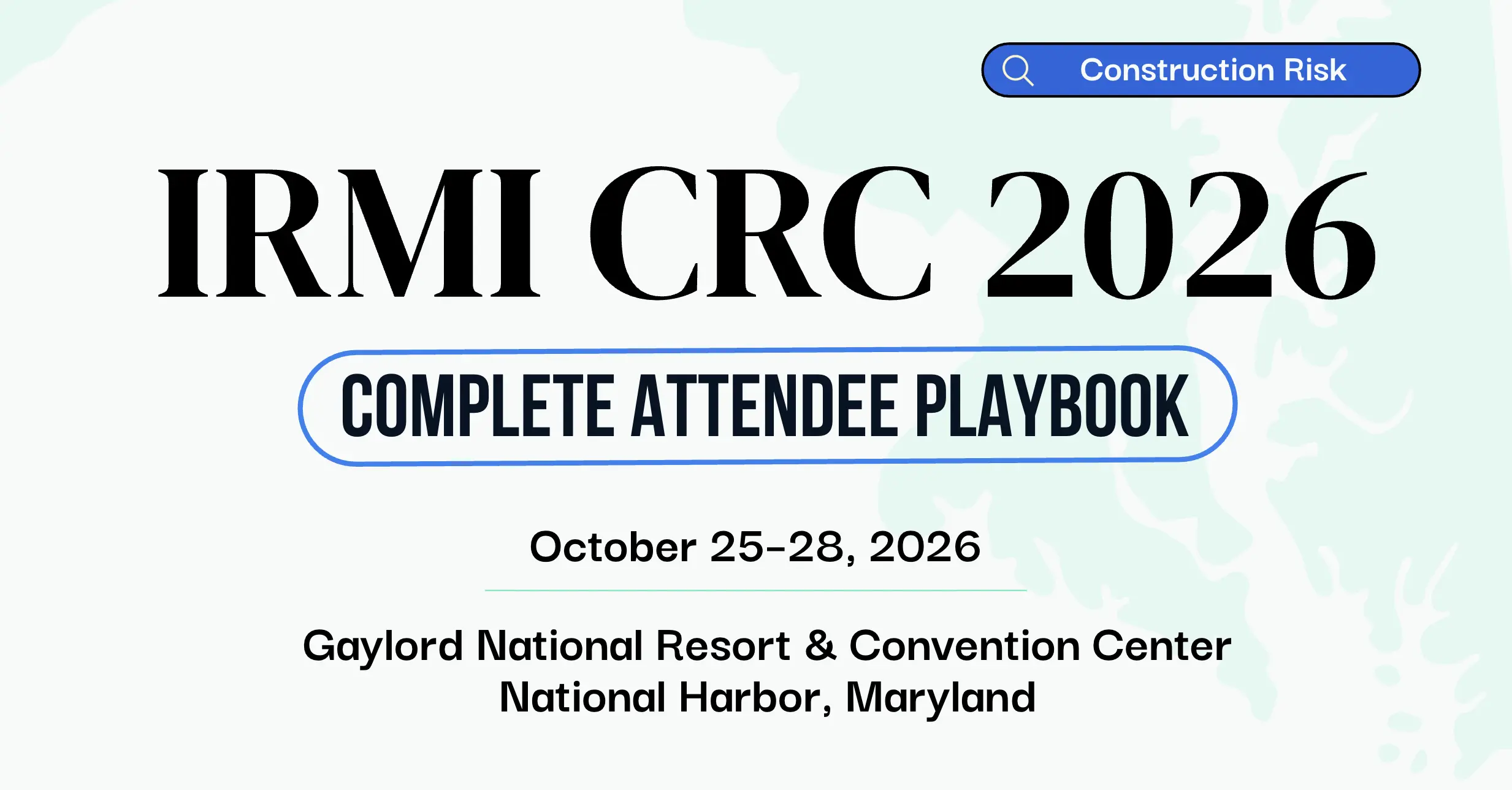
IRMI Construction Risk Conference 2026 | Complete Attendee Playbook
Construction risk has a special talent for looking manageable right up until it isn't.irmi
One missed notice.
One subcontractor whose insurance looked fine until someone read the endorsement.
One contract clause everyone assumed meant the same thing.
One builder's risk claim complicated enough to require its own conference room.
That is the world the IRMI Construction Risk Conference (CRC) is built around.
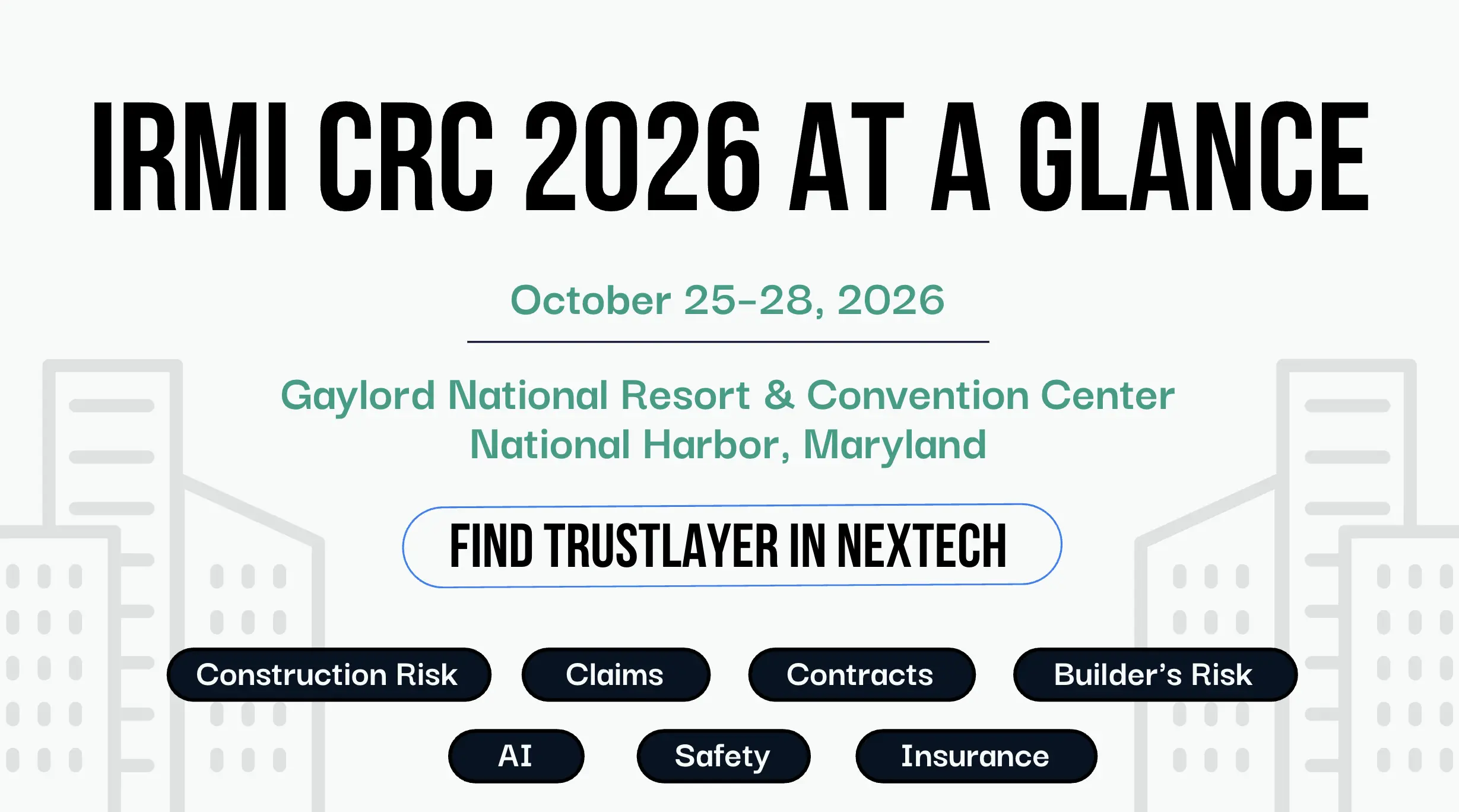
From October 25–28, construction risk managers, contractors, brokers, attorneys, carriers, claims professionals, safety leaders, and insurance specialists will gather at the Gaylord National Resort & Convention Center in National Harbor, Maryland, for four days focused on the things that determine whether risk is transferred, retained, insured, prevented—or discovered after something has already gone wrong.
And the 2026 agenda gets into it.
Subcontractor default.
Additional insured endorsements.
Builder's risk.
Claims.
Contractual risk transfer.
AI.
Data centers.
Safety.
Environmental exposure.
Captives.
Extreme weather.
Professional liability.
This is not a conference built around vague predictions about "the future of risk."
It is much more interested in what happens Monday morning.
TrustLayer will also be at CRC 2026 in the NexTech Kiosk area, where we'll be talking with construction risk professionals about vendor compliance, certificate tracking, insurance verification, and what happens when collecting the document is no longer enough.
This playbook will help you figure out what to prioritize, where to stay, what to do around National Harbor, where to escape for dinner, and how to leave CRC with something more useful than 73 pictures of PowerPoint slides.
IRMI CRC 2026 Conference Snapshot
Event IRMI Construction Risk Conference 2026
Dates October 25–28, 2026
Location Gaylord National Resort & Convention Center
City National Harbor, Maryland
Audience Construction risk, insurance, legal, claims, safety, contractor and broker professionals
Published Sessions 77
TrustLayer Attending Yes
TrustLayer Presence NexTech Kiosk
Major Themes Construction insurance, claims, contracts, risk transfer, AI, safety, builder's risk and subcontractor risk
The 2026 program currently includes 77 published sessions, beginning with Sunday preconference education and continuing through Wednesday morning.
Quick Answers
Q: What is the IRMI Construction Risk Conference?
IRMI CRC is an annual conference focused specifically on construction risk management and insurance, including contractual risk transfer, claims, builder's risk, commercial liability, professional liability, safety, insurance program design, technology, and emerging construction exposures.
Q: When is IRMI CRC 2026?
The conference runs Sunday, October 25 through Wednesday, October 28, 2026.
Q: Where is IRMI CRC 2026?
The conference takes place at the Gaylord National Resort & Convention Center in National Harbor, Maryland, just outside Washington, DC.
Q: Will TrustLayer be at IRMI CRC?
Yes. TrustLayer will be in the conference's NexTech Kiosk area.
Q: Who should attend IRMI CRC?
CRC is especially relevant for construction risk managers, general contractors, insurance brokers, carriers, attorneys, claims professionals, safety leaders, owners, insurance directors, and anyone responsible for construction contracts or third-party risk.
Q: What will IRMI CRC 2026 cover?
The 2026 agenda includes sessions on construction economics, subcontractor default, builder's risk, contractual risk transfer, additional insured endorsements, AI, data center construction, claims, extreme weather, workforce safety, commercial auto, cyber risk, environmental exposure, professional liability, and insurance capacity.
Why IRMI CRC Matters in 2026
Construction risk is not getting simpler.
Projects are getting larger.
The subcontractor network underneath those projects is getting more complex.
Contracts carry more requirements.
Insurance markets move.
Extreme weather creates new assumptions.
Data center construction is exploding.
Artificial intelligence is entering workflows that were already difficult to audit.
And the cost of figuring out that something was wrong after the loss remains significantly higher than figuring it out before work starts.
That is what makes CRC different from many broader insurance conferences.
The conversation starts much closer to the actual exposure.
You'll hear from people negotiating construction agreements, placing coverage, defending claims, managing safety programs, underwriting contractors, running risk departments, and dealing with the operational consequences when requirements and reality stop matching.
And sometimes the entire problem comes down to something deceptively small.
A certificate was collected.
The box was checked.
Everyone moved on.
Then someone discovered that compliance wasn't coverage.
There is literally a 2026 CRC session titled "When Compliance Isn't Coverage: Navigating Subcontractor Insurance Realities," presented by Hyder Naqvi of Injala and Renee Whitmore of Whiting-Turner. It runs twice on Monday.
That distinction is exactly why modern insurance compliance has to go beyond document collection.
The TrustLayer Resource Center includes deeper guidance on COI tracking, vendor risk, insurance compliance, endorsements, and the operational gaps that can remain hidden even after a certificate has been received.
TrustLayer at IRMI CRC 2026
You'll find TrustLayer in the NexTech Kiosk area.
That feels appropriate.
Because the interesting part of construction compliance right now is not finding a prettier way to store a PDF.
It's figuring out what should happen after the document arrives.
Is it current?
Does it satisfy the requirement?
Is something missing?
Did coverage expire?
Was the right endorsement provided?
Has a requirement changed?
Which subcontractors need attention now?
And can someone answer those questions without opening six spreadsheets and searching an inbox?
That's the work we're interested in.
If your team is still piecing together vendor insurance through email, spreadsheets, shared drives, and individual follow-up, stop by the kiosk and show us the ugly version.
Those conversations are usually more interesting than the polished ones.
You can also explore TrustLayer's Free Tools Hub before the conference to test common compliance questions and get a clearer sense of where your current process may have gaps.
And if something you hear at CRC sends you down a construction-risk rabbit hole, the TrustLayer Resource Center gives you guides, research, articles, and practical resources to keep going.
How to Approach the IRMI CRC 2026 Agenda
There are 77 published sessions.
You are not going to see all of them.
Nor should you.
The better strategy is to decide what kind of problem you need help thinking through.
Then follow that thread across the conference.
The official IRMI CRC agenda should remain your source for final session times and changes as October approaches.
Here is how the week currently breaks down.
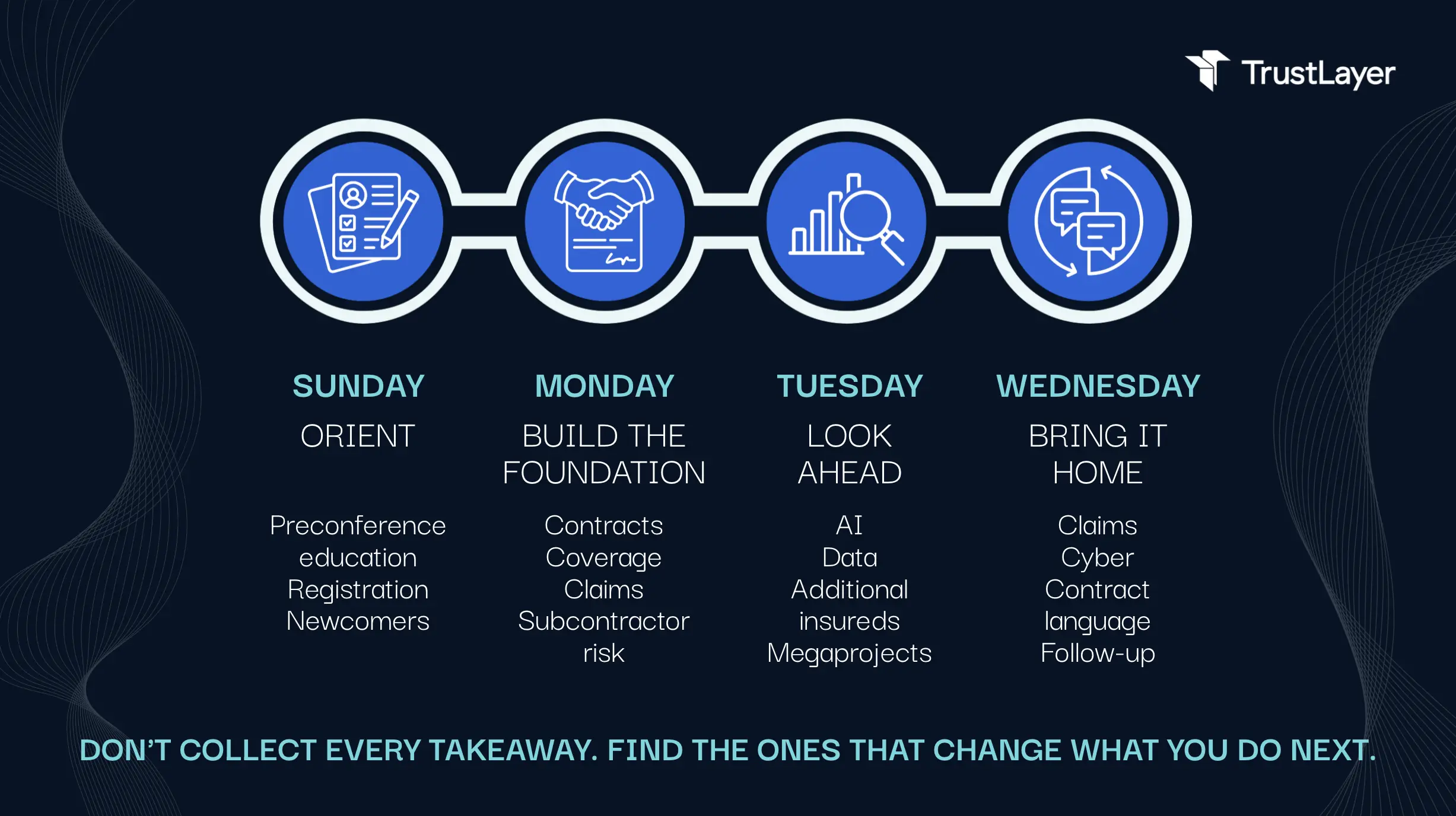
Sunday, October 25 — Learn Before the Crowd Arrives
Sunday is the setup day.
The conference begins with the Commercial Liability Insurance for Contractors preconference seminar from 8:00 a.m. to 4:00 p.m., followed by registration and the Newcomers' Reception from 4:15 to 5:15 p.m.
If you're new to CRC, go to the reception.
A conference gets much smaller once you know five people.
And knowing five people on Sunday is substantially easier than attempting to introduce yourself to 1,700 people on Monday morning.
Monday, October 26 — Contracts, Coverage and the Stuff That Goes Wrong
Monday opens with Anirban Basu's economic update for the construction industry, followed by one of the densest days on the program.
This is where CRC gets very CRC.
Reporting Late, Paying More
The session examines what happens when notice requirements are missed.
Because apparently discovering that a contractual deadline mattered after the deadline passed is still not a particularly good risk strategy.
Subcontractor Default Risk
Richard Brown and Daniel Averna dig into emerging insurance coverage and claims issues related to subcontractor default.
For companies managing large subcontractor populations, this is also where vendor qualification and ongoing insurance compliance begin overlapping with broader project risk.
Introduction to Risk Transfer in Construction
Kevin Dreher and Haley Casper provide a foundational look at contractual risk transfer.
This is a useful session whether you're new to construction risk or simply need to remember why six words buried in a contract can eventually become everyone's problem.
Managing High-Stakes Data Center Construction Risk
Data centers appear repeatedly throughout the 2026 agenda, reflecting just how significant that construction market has become.
Monday afternoon includes Managing the High Stakes Risks of Data Center Construction: A GC's Guide with Greg Podolak and Dana Mango.
When Compliance Isn't Coverage
This one should be on the radar for anyone responsible for subcontractor insurance.
The title basically says the thing.
Receiving a document is not the same as proving the requirement has been satisfied.
That same distinction is one of the reasons teams eventually outgrow manual certificate processes. If that's already happening inside your organization, the Free Tools Hub gives you a quick place to assess the problem before coming to the NexTech area.
Women in Construction Workshop
Monday closes its educational programming with Amplifying Your Voice, featuring Ashley Stinson of Granite Construction and Emily Glanz of Cottingham & Butler.
The Monday Social follows from 5:00 to 6:30 p.m.
Go.
You did not travel to National Harbor to answer email alone in your hotel room.
Tuesday, October 27 — AI, Additional Insureds and Emerging Risk
Tuesday may be the strongest "where construction risk is heading next" day on the agenda.
2031—An Artificial Intelligence Odyssey
Cheri Hanes of AXA XL and Hugh Seaton of The Link.ai lead a morning session on AI construction scenario planning.
The timing is good.
Construction organizations are moving past "Should we use AI?"
The harder questions now are:
What decisions does it influence?
What data does it use?
What happens when the data is wrong?
Who reviews the output?
Who owns the result?
Those are much more interesting questions.
Decoding Additional Insured Endorsements
Christopher Ruggiero and Amanda Peppel tackle additional insured endorsements and contractual risk transfer.
For teams managing certificates at scale, endorsements are often where the comforting green checkmark meets the actual policy language.
Data Center Construction at Scale
Tuesday afternoon returns to data centers with a session on operational risk, logistics, and workforce realities.
When Data Becomes Risk
One of the more interesting technology sessions comes Tuesday afternoon:
When Data Becomes Risk: How AI Shapes Financial, Delay, and Reputational Exposure in Construction.
That's the conversation worth having.
Not just how AI creates efficiency.
How it creates a new dependency.
The Prequalification Puzzle
Liberty Mutual's Nate Rosenker and Whiting-Turner's Adam Frolish examine underwriting and managing mega-subcontractor packages on megaprojects.
For anyone operating at scale, the underlying problem will sound familiar:
More third parties means more information.
More information means more dependencies.
And eventually the spreadsheet starts lying to you.
The Tuesday reception runs from 4:00 to 5:30 p.m.
Wednesday, October 28 — Contracts and Coverage Get the Last Word
CRC's final morning stays practical.
Sessions include:
- A Marine and Builder's Risk Perspective on Data Center Projects
- Clauses that Bite: Perspectives on Contract Risk & Negotiation
- The Spectrum of Control Around Insurance Claims
- When Excess Breaks First
- Building Resilience: Cyber Risk Assessment and Claims Prevention
- Project-Specific Professional Liability on Large Projects
Wednesday is a good day to stop collecting new ideas.
Go back to the ones that bothered you.
Ask one more question.
Find the speaker.
Return to the NexTech Kiosk.
Schedule the follow-up.
A conference becomes useful when something happens after it.
What We're Watching at CRC
Compliance Versus Coverage
This might be the biggest TrustLayer-adjacent theme on the agenda.
Insurance compliance is often treated as administrative work.
Until it isn't.
The moment a loss occurs, documentation becomes evidence.
Requirements become contract language.
Dates matter.
Endorsements matter.
Exclusions matter.
That's why a modern compliance program cannot stop at "certificate received."
If you're trying to understand what a more continuous approach looks like, browse TrustLayer's insurance compliance resources before the conference and bring your questions to the NexTech Kiosk.
AI Is Becoming a Risk Conversation
The construction industry has spent several years discussing AI primarily as an efficiency opportunity.
CRC is asking another question:
What risk does the data create?
That is healthy.
If an automated system influences financial decisions, scheduling, claims, compliance, safety, or project execution, organizations need to understand not just what the system can do but how decisions can later be explained.
Efficiency without accountability has a habit of becoming somebody else's problem.
Data Centers Are Becoming Their Own Construction Risk Category
Data centers appear repeatedly throughout the CRC agenda.
That makes sense.
These projects combine enormous capital investment, complicated contractor ecosystems, specialized technology, demanding schedules, sophisticated insurance programs, and very expensive consequences when something goes wrong.
Risk teams supporting this work should pay attention to the combination of:
- Builder's risk
- Subcontractor default
- Professional liability
- Workforce issues
- Logistics
- Water and property damage
- Operational dependencies
CRC gives attendees several opportunities to look at that ecosystem from different sides.
Where to Stay for IRMI CRC 2026
The host property is the Gaylord National Resort & Convention Center.
All official conference functions and educational sessions take place there.
IRMI's conference rate is $249 per night plus taxes and fees for single or double occupancy, subject to availability, and the conference room block is scheduled to remain available through October 1. You must be a registered conference attendee to access the official block.
The Gaylord also places you directly in National Harbor, meaning restaurants, waterfront attractions, shopping, and evening entertainment are all within walking distance.
If you're flying in, Ronald Reagan Washington National Airport is generally the most convenient major airport for National Harbor.
IRMI estimates the trip from DCA to the Gaylord at roughly 20–25 minutes.
Things to Do Around National Harbor
You're in a pretty good spot.
Do not spend four days seeing only carpeting patterned specifically to remind you that you're at a convention center.
Walk the National Harbor Waterfront
Start with National Harbor itself.
The waterfront gives you restaurants, shops, public art, walking paths, bars, and plenty of places to continue a conference conversation without arranging another "official meeting."
It's also directly outside the Gaylord.
Easy wins matter.
Ride the Capital Wheel
The Capital Wheel rises above the Potomac at National Harbor and gives you views toward Washington and Northern Virginia.
It's close enough to do after sessions without turning the evening into another logistical project.
Take the Water Taxi to Old Town Alexandria
This is the one I'd actually make time for.
Historic Old Town Alexandria sits across the Potomac and gives you brick sidewalks, independent shops, restaurants, bars, historic architecture, and a much different atmosphere than the conference resort.
Depending on seasonal schedules, the Potomac Water Taxi can connect National Harbor with Alexandria.
If the timing works, take it.
A boat is substantially more interesting than another rideshare.
Where to Eat Around IRMI CRC
The Fish Market
If you head into Old Town, The Fish Market is the kind of place that actually fits a construction-risk conference trip.
Seafood.
Old Town.
Not precious.
Easy group dinner.
Good place to continue a conversation without feeling like you accidentally booked a four-hour tasting menu.
Ada's on the River
For a more polished client dinner, Ada's on the River sits on the Alexandria waterfront and focuses on wood-fired seafood and steaks.
Book ahead if you're taking a group.
Vola's Dockside Grill
Vola's Dockside Grill gives you a more casual seafood option on the Alexandria waterfront.
It works well when everyone wants a real dinner but nobody wants another formal event.
Blackwall Hitch
Blackwall Hitch Alexandria offers seafood, cocktails, and waterfront atmosphere and is another useful option for a customer or team dinner in Old Town.
MGM National Harbor
If nobody wants to cross the river, MGM National Harbor is only a short ride from the Gaylord and gives you additional restaurants, bars, entertainment, and nightlife.
You do not have to gamble.
You may simply eat.
Las Vegas has not copyrighted that concept.
IMAGE PLACEHOLDER — NATIONAL HARBOR + OLD TOWN GUIDE
Penji graphic goes here
Feature:
- Gaylord National
- National Harbor Waterfront
- Capital Wheel
- MGM National Harbor
- Potomac Water Taxi
- Old Town Alexandria
- The Fish Market
Suggested title:
Beyond the Conference: National Harbor + Old Town
Suggested alt text: National Harbor and Old Town Alexandria guide for IRMI Construction Risk Conference attendees showing the Gaylord, waterfront, Capital Wheel, water taxi, restaurants and attractions.
Who Should Attend IRMI CRC?
Construction Risk Managers
Obviously.
But particularly those working across contract review, insurance programs, subcontractor qualification, claims, safety, or risk transfer.
CRC gives you the opportunity to hear the same problem described by contractors, brokers, carriers, lawyers, and claims professionals.
That perspective is hard to replicate internally.
General Contractors
GCs managing large subcontractor populations should prioritize sessions covering default risk, additional insureds, builder's risk, prequalification, claims, and contractual risk transfer.
If vendor compliance is already becoming difficult to manage manually, try the TrustLayer Free Tools Hub before coming to the conference so you have a clearer idea of the questions you want answered.
Insurance Brokers
Construction brokers can use CRC to get closer to the operational problems clients are trying to solve.
The value is not just learning about coverage.
It's understanding why the client needs it.
Attorneys
If you negotiate, draft, litigate, or interpret construction contracts, half this agenda looks like it was designed specifically to make sure you never get an early flight home.
Additional insureds.
Liability exclusions.
Notice.
Professional liability.
Contract clauses.
Claims control.
You'll be fine.
Claims Professionals
CRC offers the opportunity to look upstream.
Not only what happened after the loss, but which contractual, operational, insurance, or documentation decision may have contributed to it.
Technology Leaders
Technology professionals should pay particular attention to the AI and data-risk programming.
The question is no longer whether construction will automate more of the work.
The question is what organizations need to verify, govern, and preserve when they do.
What to Pack for IRMI CRC
Keep it simple:
- Comfortable shoes
- Business-casual layers
- Portable charger
- Refillable water bottle
- Laptop or tablet if you actually take notes that way
- Conference app
- Something warmer than you think you need for conference rooms
- Enough white space in your schedule to talk to people
No one has ever returned from a conference saying:
"I wish I had scheduled three more back-to-back meetings."
Get More From CRC
Go to the Newcomers' Reception if you're new. Walking into Monday already knowing people changes the conference.
Don't treat every session equally. Follow a problem, not a schedule.
Talk to speakers. The 15 minutes after a session can be more valuable than the 60 minutes during it.
Visit NexTech. Especially if one of your problems involves something your team is still solving manually.
Leave the Gaylord once. National Harbor is outside. Alexandria is across the river. You are allowed.
Write your three takeaways before flying home. If you can't identify the three things that deserve follow-up, the conference probably hasn't finished yet.
Keep Learning Before and After CRC
If CRC gets you thinking harder about third-party insurance, certificate tracking, subcontractor risk, or the gap between having documentation and having proof, keep going.
The TrustLayer Resource Center brings together practical guidance on insurance compliance, vendor risk, COI workflows, construction risk, and the operational work behind stronger compliance programs.
If you want something more interactive, start with the Free Tools Hub. It's designed to help risk, insurance, and compliance professionals test everyday questions without needing to begin with a sales conversation.
And if the conference makes it clear that your current process has outgrown the spreadsheet, you can see TrustLayer in action when you're ready.
Frequently Asked Questions
Q: When is the IRMI Construction Risk Conference 2026?
IRMI CRC runs October 25–28, 2026 in National Harbor, Maryland.
Q: Where is IRMI CRC 2026?
The conference is held at the Gaylord National Resort & Convention Center in National Harbor, Maryland.
Q: How many sessions are on the 2026 IRMI CRC agenda?
The current published agenda lists 77 sessions across October 25–28.
Q: What topics does IRMI CRC cover?
The 2026 agenda includes contractual risk transfer, builder's risk, subcontractor default, claims, additional insured endorsements, construction economics, AI, data centers, environmental exposure, safety, captives, commercial liability, cyber risk, professional liability and more.
Q: Will TrustLayer be at IRMI CRC 2026?
Yes. TrustLayer will be participating in the conference's NexTech Kiosk area.
Q: What are the NexTech Kiosks?
IRMI uses the NexTech area to showcase emerging ConTech and InsurTech solutions relevant to construction risk management and insurance.
Q: Is there programming for first-time attendees?
Yes. The Newcomers' Reception takes place Sunday, October 25, from 4:15 to 5:15 p.m.
Q: Is there a preconference seminar?
Yes. Commercial Liability Insurance for Contractors runs Sunday, October 25, from 8:00 a.m. to 4:00 p.m.
Q: Is there a Women in Construction event?
Yes. Amplifying Your Voice, the Women in Construction Workshop, runs Monday, October 26, from 4:00 to 5:00 p.m.
Q: Which airport is closest to IRMI CRC?
Ronald Reagan Washington National Airport is generally the most convenient major airport for National Harbor. IRMI estimates the drive to the Gaylord at roughly 20–25 minutes.
Q: Where can I learn more about construction insurance compliance?
Start with the TrustLayer Resource Center, where you can explore practical content on COIs, insurance compliance, vendor risk, endorsements, third-party risk, and construction-focused workflows.
See You at IRMI CRC
Construction risk is a strange job.
Success often looks like nothing happened.
The subcontractor was properly insured.
The requirement was caught.
The clause was negotiated.
The claim was reported.
The documentation existed.
The risk was seen early enough that nobody ever had to tell the story on a conference stage.
CRC is where the people responsible for making those things happen get together and compare notes.
We'll be there too.
Find TrustLayer in the NexTech Kiosk area.
Bring us the workflow that's driving your team nuts.
Bring us the certificate process nobody wants to own.
Bring us the question nobody can answer without opening a spreadsheet.
Or just say hello.
When you're ready to see what a different insurance compliance workflow could look like, meet with TrustLayer.
You might also like

.png)