Reduce Time-to-Compliant: Faster Compliance Without Lower Standards

Every risk manager knows the moment. A subcontractor stands at the gate, crew ready, equipment staged, and someone in the field calls to ask if they can start. The certificate of insurance came in yesterday, but nobody has reviewed it. Do you hold the job and burn money on idle labor, or wave them through and hope the paperwork checks out?
That tension sits at the heart of every effort to reduce time-to-compliant. Speed and rigor are usually framed as opposites: move faster and you'll miss things, or check everything and you'll slow the business down. That framing is wrong, and accepting it is an expensive illusion. The organizations that get vendors compliant fastest rarely cut corners. They redesigned the process so the slow parts stopped being slow.
What follows is a practical look at where compliance time actually goes, what fixes hold up under scrutiny, and how to prove to leadership that faster compliance without lower standards is measurable, not just claimed.
The High Cost of Slow Compliance in Modern Risk Management
Slow compliance doesn't show up as a single line item, which is exactly why it gets ignored. It hides in project delays, frustrated vendors, and staff hours spent chasing documents instead of evaluating risk. By the time anyone tallies it up, the cost has been spread across a dozen budgets.
The most visible cost is operational. When a vendor can't start work until their COI is approved, every day spent reviewing is a day of lost productivity. In construction, property management, and logistics, that can mean rescheduled crews, missed tenant move-ins, or penalty clauses kicking in.
The less visible cost is worse. Long approval cycles create pressure to make exceptions, and exceptions are where coverage gaps live. A project manager who has waited two weeks for a sign-off is far more likely to let a vendor onto the site "just this once." Multiply that across a portfolio, and you have a compliance program that looks strict on paper but is practically worthless in the field.
There is also a relationship cost. Vendors and their brokers remember which clients make them jump through confusing, repetitive hoops. Good subcontractors have options, and a reputation for painful onboarding quietly shrinks the pool of partners willing to work with you. In other words, slow compliance doesn't protect you. It just moves the risk somewhere harder to see.
Identifying and Eliminating Traditional Bottlenecks
Before buying anything or rewriting any policy, map where the days actually go. Most teams assume the delay is on the vendor side. In practice, a large share of time-to-compliant is consumed internally: documents sitting in inboxes, waiting for the one person who knows the requirements, or bouncing between departments with no clear owner.
A simple exercise helps. Pick ten recent vendor onboardings and trace each one from first request to final approval, noting every handoff and every pause. Patterns appear quickly, and they usually fall into two categories.
The Pitfalls of Manual Document Review
Manual review is slow, but slowness isn't its biggest flaw. The bigger problem is inconsistency. Two reviewers looking at the same certificate will often reach different conclusions, especially on details like additional insured endorsements, waiver of subrogation language, or whether a limit applies per occurrence or in aggregate.
A COI is a snapshot, not the policy itself. Think of it like a photo of a car that shows the engine but not the wheels: it can look complete while missing the parts that actually make it go. A tired reviewer scanning dozens of certificates a day is most likely to miss that the endorsement is referenced but not attached. Manual review also scales poorly, so volume spikes at the start of a project season turn into backlogs measured in weeks.
Communication Gaps Between Stakeholders
The second bottleneck is fragmented visibility. Project teams know who is about to show up on site. Site managers know who is already there. Central risk management knows what coverage is required. Rarely does one person see all three at once.
These data silos hide coverage gaps until a claim occurs. A vendor's policy lapses, the risk team sends a notice, the project manager never sees it, and the site lead keeps letting the crew in. Nobody did anything wrong individually. The process simply had no shared view of status, so the gap stayed invisible until it became expensive.
Standardizing Requirements to Accelerate Onboarding
Ambiguous requirements create back-and-forth, and back-and-forth is the single biggest driver of slow onboarding. If a vendor's broker has to guess what you need, they will guess wrong, and you'll spend another week on corrections.
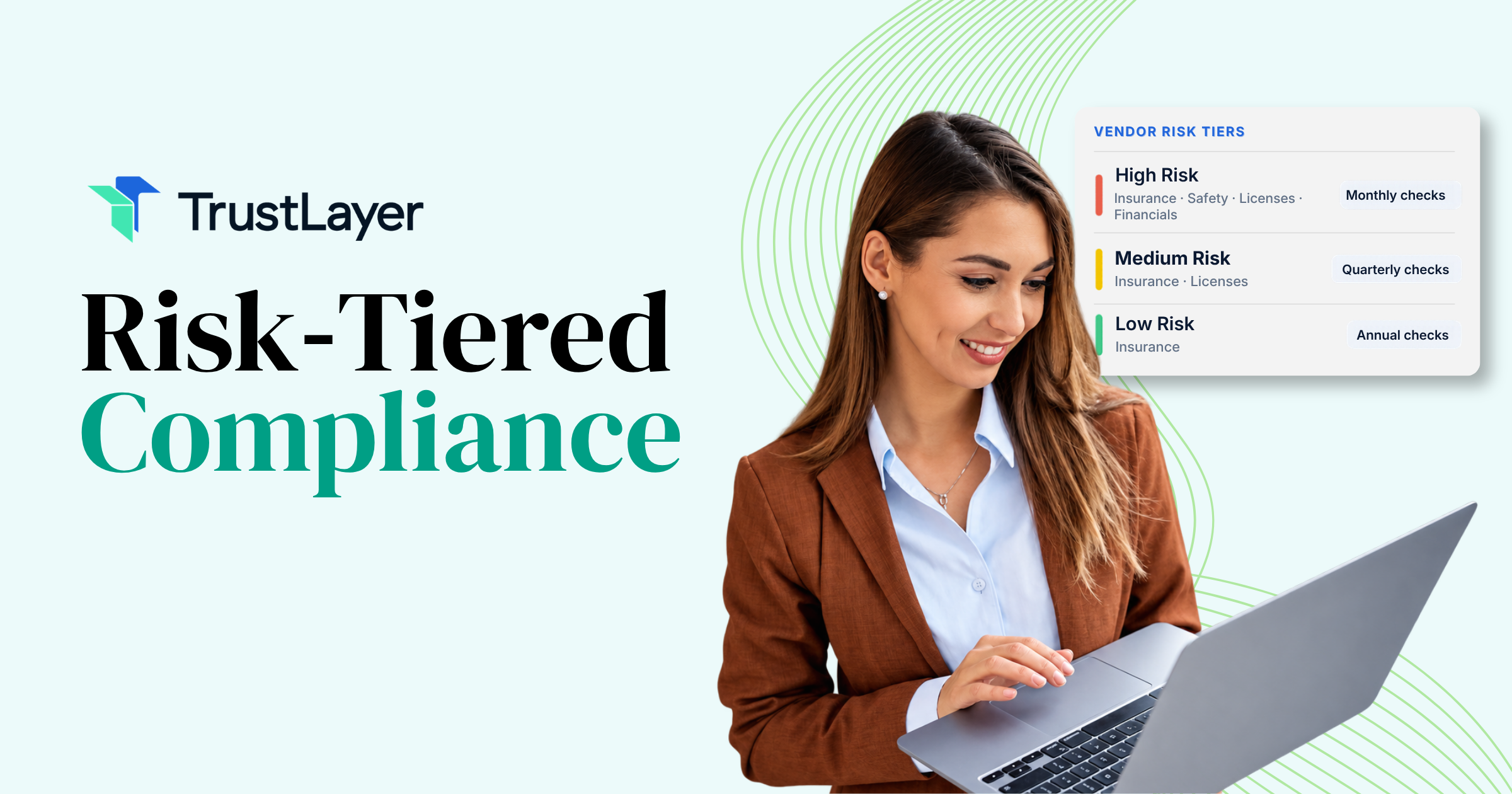
The fix is to build requirement templates by risk tier instead of writing bespoke requirements for every relationship. A janitorial vendor, a roofing subcontractor, and a software consultant carry very different exposures, but within each category the needs are fairly predictable. A good tiering structure might look like this:
- Low-risk tier: Office suppliers, remote consultants, and delivery-only vendors. Basic general liability and, where applicable, workers' compensation.
- Moderate-risk tier: On-site service providers, such as cleaning or landscaping crews. Higher limits, auto liability, and additional insured status.
- High-risk tier: Trades working at height, with heavy equipment, or with hazardous materials. Umbrella coverage, specific endorsements, and primary and non-contributory wording.
Once tiers exist, communicate them in plain language. Send brokers a clear checklist, including sample endorsement wording, at the very first request. Vague instructions like "provide adequate coverage" guarantee a second round of review.
Standardization doesn't lower your standards. It makes them legible. The bar stays exactly where it was, but now everyone can see it on day one instead of discovering it on day ten.
Automating Verification Without Sacrificing Accuracy
Automation earns skepticism in risk management for good reason. A system that rubber-stamps documents faster is just a quicker way to accept bad coverage. The goal isn't to remove human judgment, but to stop wasting it on work that doesn't need it.
A useful way to think about this is synchronous versus asynchronous workflows. Synchronous workflows require verification to finish before work can begin. They belong with high-risk or regulated activities: the crane operator, the electrical contractor, the vendor handling sensitive data. Waiting is the point.
Asynchronous workflows let routine work proceed while verification runs in parallel, with clear escalation if something fails. They suit low-risk, repeat vendors where a short delay causes more damage than a small, temporary gap. Applying synchronous rigor to every office supply vendor buries compliance teams and rushes high-risk reviews to clear the backlog.
The accuracy question comes down to where people spend attention. When straightforward checks happen automatically, reviewers can focus on the genuinely tricky items: unusual exclusions, ambiguous endorsements, carriers with weak ratings. That is a better use of expertise, not a reduction in it.
Real-Time Tracking and Automated Follow-Ups
Much of compliance time is spent remembering to follow up. Someone has to notice that a certificate expires next month, draft the reminder, send it, and then check whether a response arrived. Repeat that across hundreds of vendors, and the follow-up work alone becomes a full-time job.
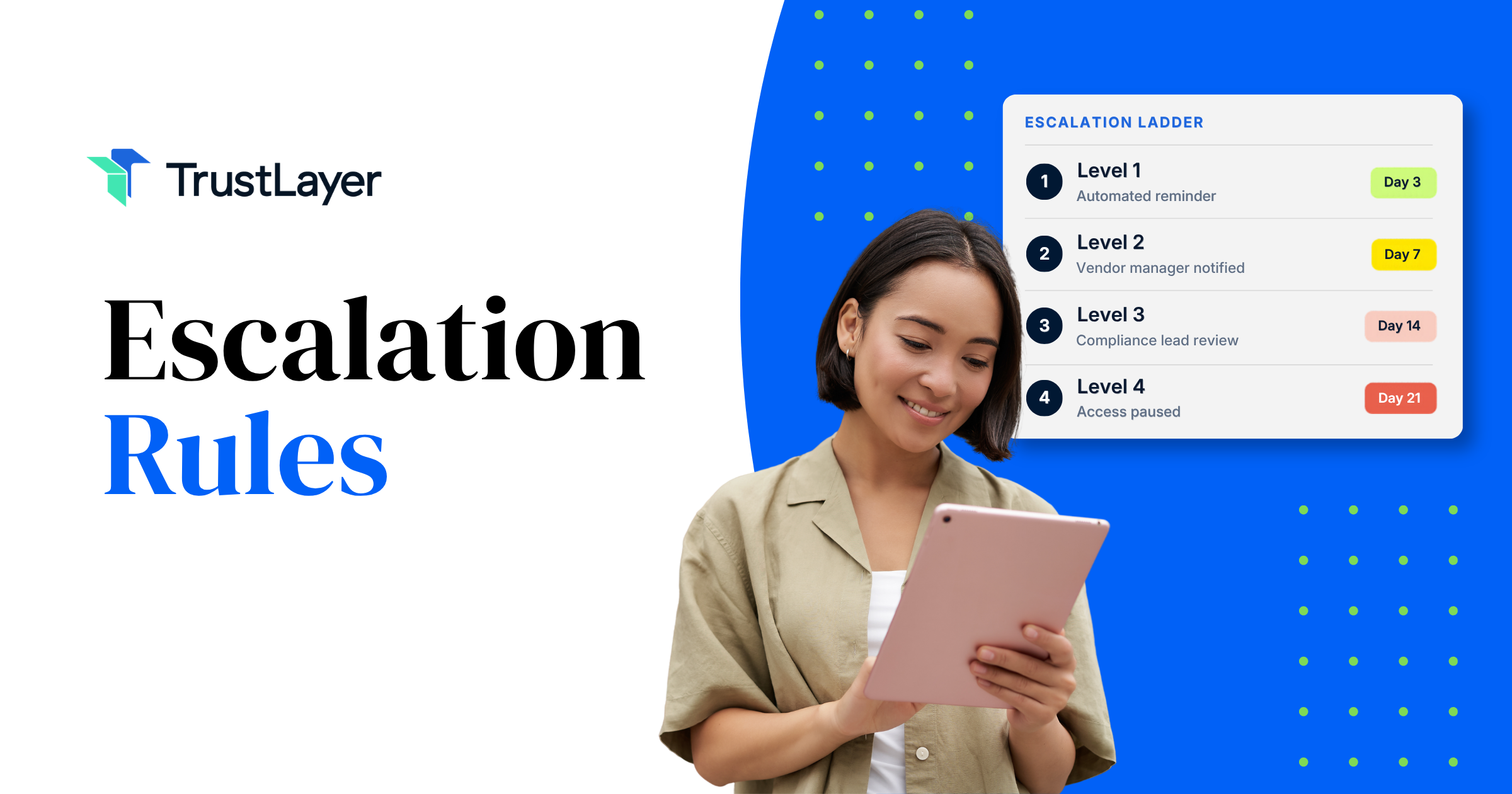
Automated reminders, sent on a predictable schedule before expiration and escalated when ignored, close that gap. Real-time status tracking lets a site manager check a vendor's standing in seconds, rather than emailing the risk team and waiting. The difference is between learning about a lapse the day it happens and discovering it during next quarter's audit.
Leveraging Digital Certificates and Direct Data Feeds
The traditional certificate is a PDF, often a scan of a printout, emailed between parties with no way to confirm it matches what the carrier actually issued. Every step in that chain creates opportunities for errors, outdated information, or, occasionally, outright fabrication.
Getting coverage information closer to its source changes the equation. When data comes from brokers or carriers through structured, verifiable channels, there is less to re-key, less to misread, and less to doubt. A document that arrives already validated against the issuing source needs far less scrutiny than one that arrives as an anonymous attachment.
This is also where industry-wide cooperation matters. Brokers spend enormous effort producing certificates and fielding verification calls, and they have every reason to prefer cleaner processes. When you ask brokers to submit through a consistent channel instead of scattered email threads, most are relieved rather than resistant.
A practical starting point:
- Identify your top 20 vendors by volume and risk.
- Ask their brokers to submit documents through a single, consistent channel.
- Track how review time and error rates change for that group versus everyone else.
That comparison gives you an internal case study and the data to justify extending the approach across the portfolio.
Building a Culture of Proactive Compliance
Tools only work if the organization stops treating compliance as an annual fire drill. Plenty of companies scramble before an audit, chasing certificates and cleaning up files, then let everything drift for eleven months. That cycle produces compliance theater: records that look good for the auditor while actual coverage status remains unknown most of the year.
A constant state of readiness requires a different governance model. The best approach is to centralize control while decentralizing execution. The central risk team sets requirements, defines tiers, owns exceptions, and monitors the whole portfolio. Project and site leads handle the day-to-day: confirming who is on site, nudging vendors, and flagging problems early. Without that split, every decision routes through a handful of people in the risk department, and they become the bottleneck.
Training matters here too, and click-through modules don't cut it. A project manager doesn't need a lecture on insurance law. They need to understand, through realistic scenarios, why letting an uninsured subcontractor onto a site can put the whole company on the hook for an injury claim. Role-specific training that connects requirements to daily decisions sticks far better than a generic quiz people finish in four minutes.
The final piece is visibility. When the people who need it can see status, compliance becomes something teams check routinely rather than something they dread.
Measuring Success: Key Metrics for Time-to-Compliant
Leadership rarely cares about the number of certificates processed. They care about business impact and program effectiveness: Is the company protected, and is the process slowing operations? Your metrics should answer both questions.
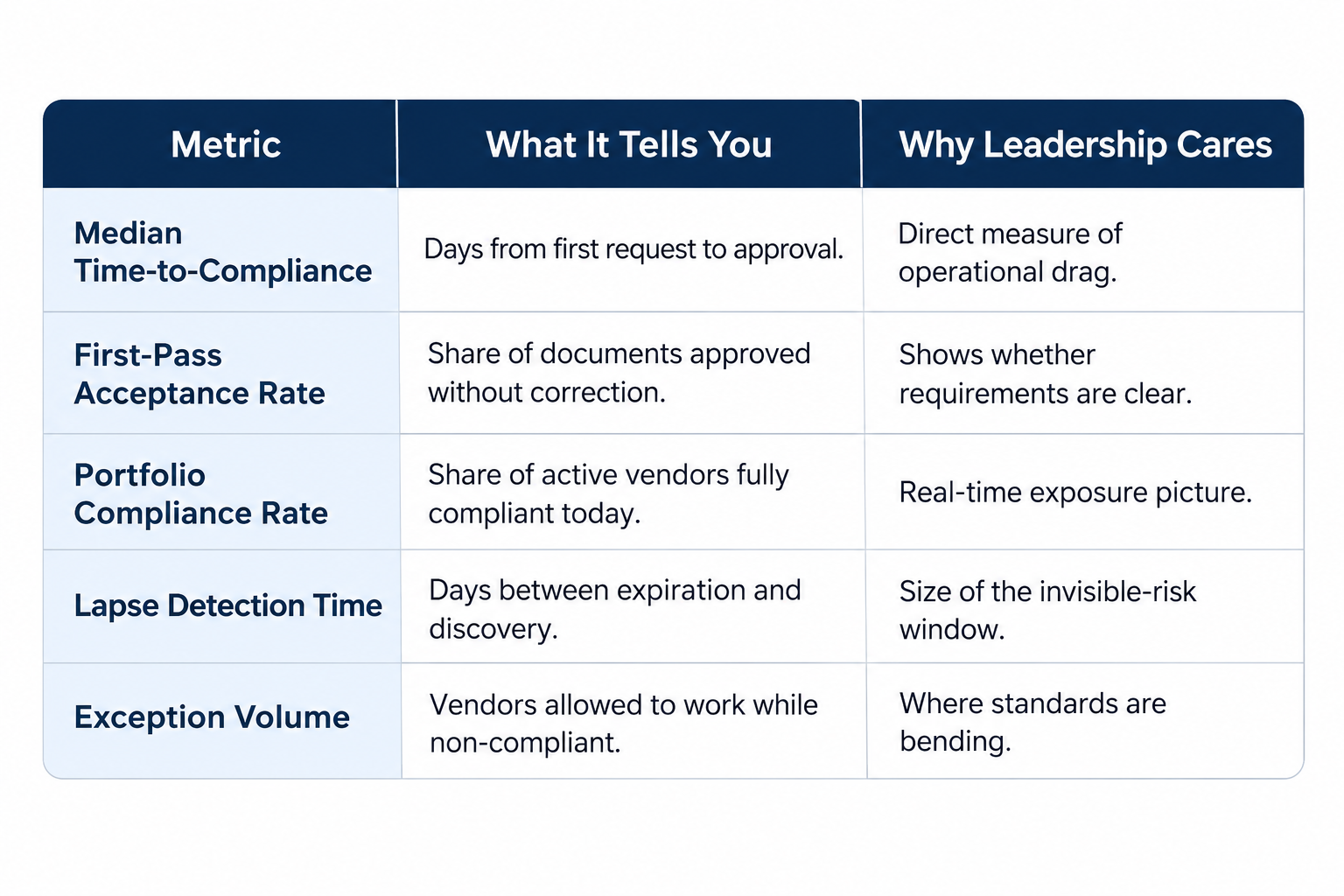
Track the median rather than the average, since a few problem vendors can skew averages badly. Watch first-pass acceptance closely too. If it's low, the issue is almost always unclear requirements, not difficult vendors.
The most important pairing is speed and exceptions. If time-to-compliant drops while exceptions rise, you haven't improved anything. You've simply moved the risk. A healthy program shows both falling together, which is the clearest evidence that faster compliance and strong standards can coexist.
Report these monthly, not annually. A dashboard that shows status at any moment shifts the conversation from periodic reporting to continuous awareness, and that shift is what separates a sustainable practice from a yearly scramble.
Optimize Your Risk Strategy with TrustLayer Experts
Cutting time-to-compliant was never about lowering the bar. It comes from removing the friction that made the bar hard to reach: vague requirements, manual rechecking, siloed teams, and follow-ups that rely on someone's memory. Fix those, and speed follows without your standards slipping an inch.
The fundamental gap in most programs isn't effort. It's structure. Tiered requirements, clear ownership, data from trustworthy sources, and metrics that show leadership the real exposure are the foundations of intelligent automation. Without them, new tools simply speed up a broken process.
If you're ready to build that foundation, TrustLayer was designed for risk managers who want certificate of insurance tracking to keep pace with the business. Set up time to talk with our team and book a consult with our insurance experts to see where your program loses time. And if you'd like to keep sharpening your approach, browse the other TrustLayer articles on vendor risk and COI management. The best compliance programs aren't the strictest or the fastest. They're the ones built so nobody has to choose.
You might also like