Risk-Tier Compliance: Scale Without Treating Every Vendor the Same
Picture two vendors on the same Monday morning. One is a crane operator about to lift steel over an occupied parking lot. The other is a caterer delivering sandwiches for a quarterly meeting. In a surprising number of companies, both get the same insurance requirements, the same paperwork chase, and the same three-week approval queue.
That sameness feels fair and thorough. It is actually an expensive illusion. Risk-tier compliance, scaling requirements to each vendor's real exposure, is how growing organizations stop drowning in paperwork without opening dangerous gaps. Below is a practical guide to building tiers, deciding where to be strict and where to ease up, and keeping the system honest as your vendor list grows from dozens to thousands.
The High Cost of One-Size-Fits-All Compliance
Uniform requirements fail in two directions. They are too heavy for low-risk vendors and often too light for high-risk ones, because whatever standard you pick has to be "reasonable" across everyone. You end up asking the window washer for $5 million in umbrella coverage while the demolition contractor squeaks by with the same baseline as the florist.
The heavy side carries real costs. Small vendors walk away from opportunities rather than buy coverage they don't need. Procurement teams wait on documents for work that poses almost no risk. Your compliance staff spends hours each week chasing certificates that, if something went wrong, would protect against a loss nobody could realistically suffer.
The light side is worse, because it stays hidden. When everyone gets the same review, nobody gets a deep one. A missing additional insured endorsement on a roofing contractor looks identical in a spreadsheet to a missing one on an office-supply vendor. One of those gaps is trivial. The other could mean a seven-figure claim lands on your balance sheet instead of the contractor's carrier.
Morale also has a cost that rarely shows up in budgets. When compliance feels like arbitrary friction, project managers start routing around it: "We'll get the paperwork later." That workaround culture creates a fundamental gap between what your policy says and what happens in the field.
Defining the Risk-Tier Compliance Framework
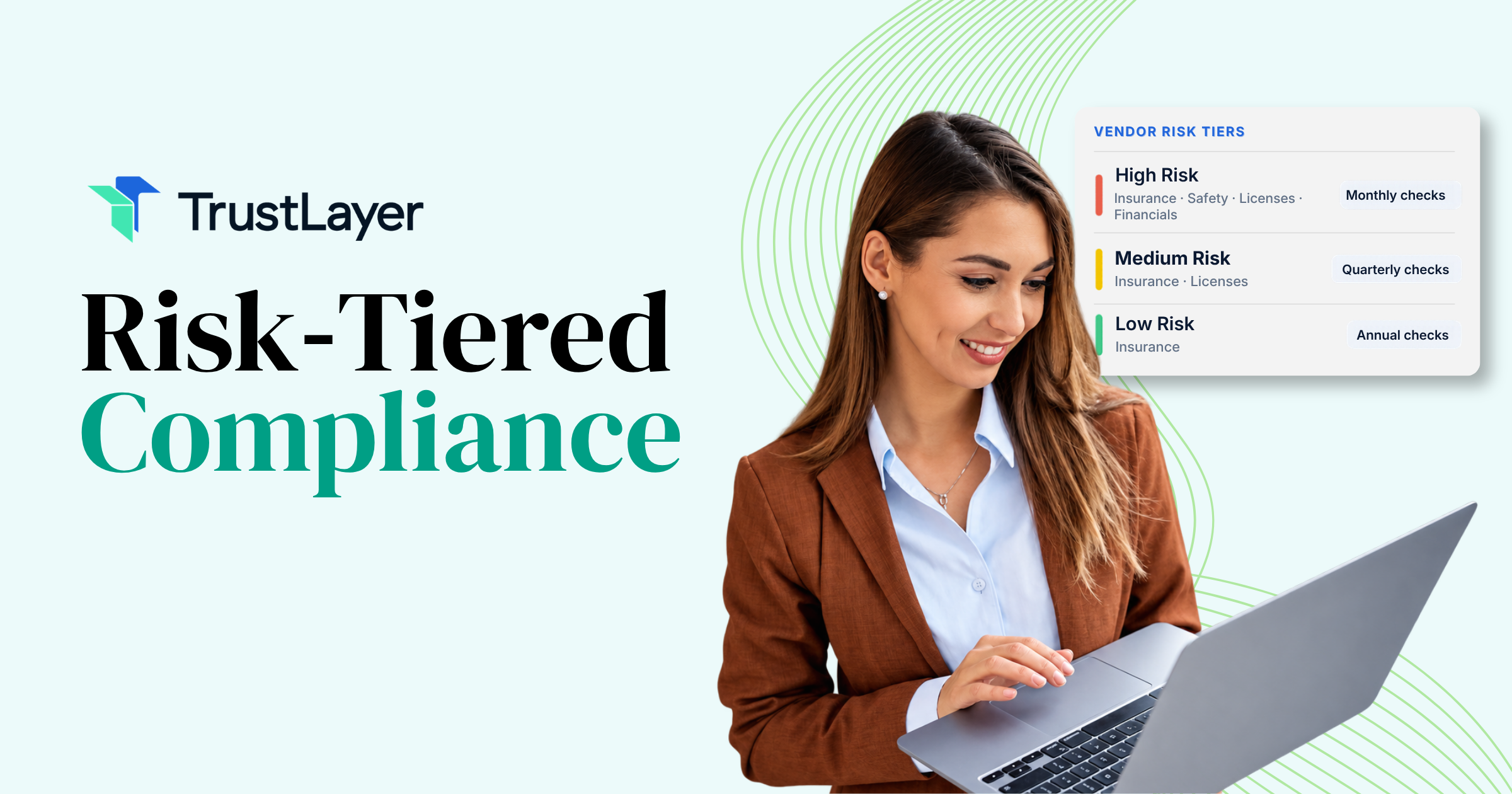
A tiered framework is simply a decision system. Instead of asking "What do we require from vendors?" you ask "What does this specific relationship expose us to, and what proof do we need to be covered for it?" The answer drives everything else: coverage types, limits, endorsements, review depth, and renewal frequency.
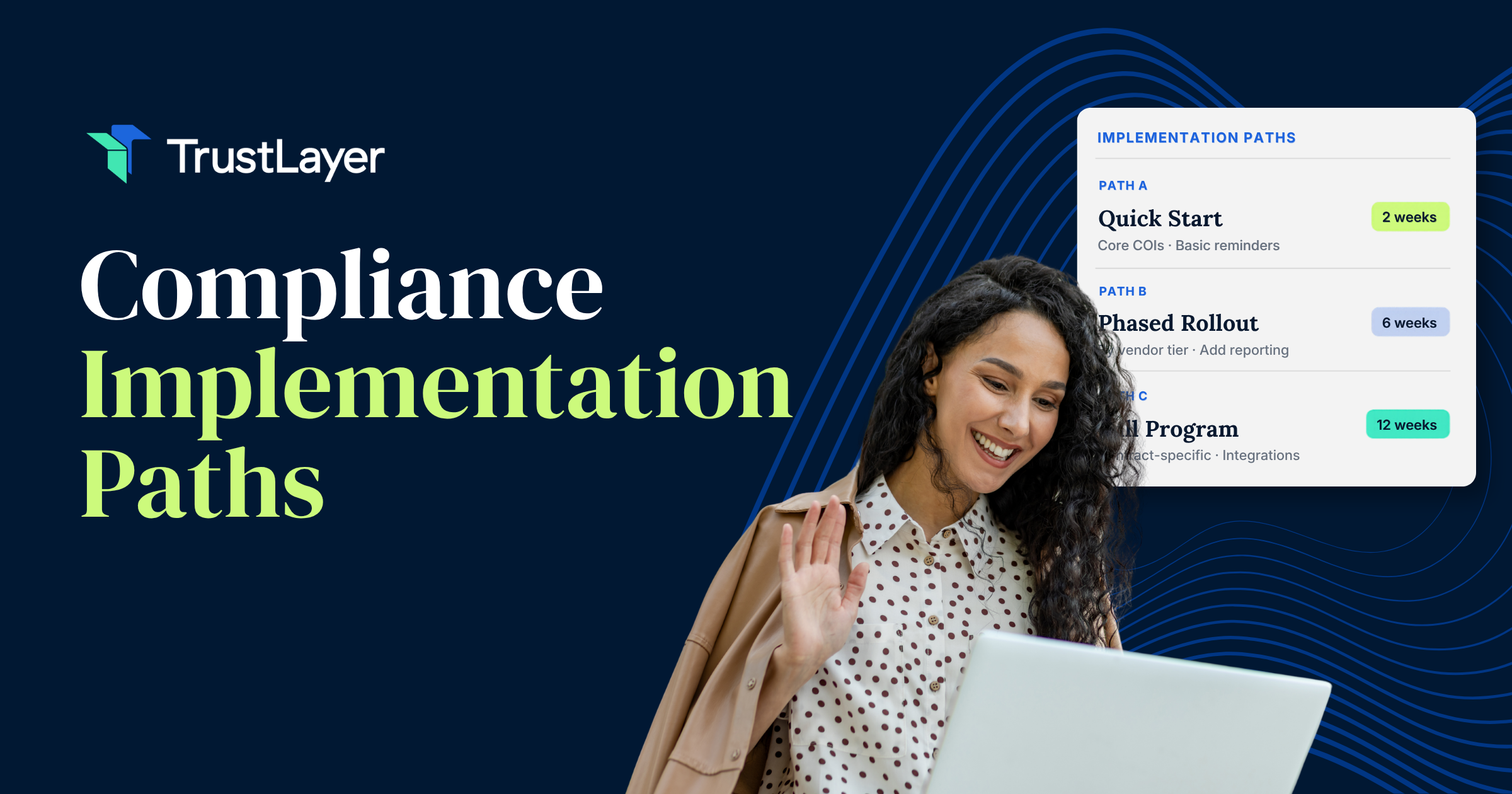
Most organizations do well with three or four tiers. With more than five, the distinctions get muddy; staff starts guessing which bucket fits. With fewer than three, you're back to near-uniform treatment. The goal is a framework simple enough that a project lead can classify a new vendor in under five minutes, with clear criteria rather than gut feel.
Categorizing Vendors by Operational Impact
Classification should rest on what the vendor actually does, where they do it, and what happens if things go wrong. A useful set of questions:
- Physical presence: Will they work on your premises, a job site, or at a customer location?
- Hazard level: Does the work involve heights, heavy equipment, hot work, vehicles, or hazardous materials?
- Data access: Will they touch customer records, payment information, or internal systems?
- Contract value and duration: Is this a one-day job or a multi-year engagement?
- Regulatory exposure: Does the work fall under industry rules where a vendor failure becomes your violation?
A typical outcome might look like this: Tier 1 covers critical vendors such as general contractors, electrical subs, and IT providers with system access. Tier 2 holds moderate-risk on-site services like janitorial or landscaping. Tier 3 includes low-touch suppliers who deliver goods and leave. Tier 4, if you use one, captures purely remote or professional services with minimal liability exposure.
Aligning Insurance Limits with Potential Exposure
Once vendors are sorted, requirements should mirror the realistic worst case for each tier. A Tier 1 electrical contractor might need general liability, auto, workers' compensation, and umbrella coverage, plus additional insured status, waiver of subrogation, and primary and non-contributory wording. A Tier 3 supplier might need only general liability at a modest limit and proof of workers' comp.
Think of it like sizing a circuit fuse. Too small and it trips constantly, shutting down perfectly safe activity. Too large and it never trips when it should. Work with your broker to set limits that match the damage each category could genuinely cause, then document the reasoning so future auditors understand why the requirements differ.
Streamlining the Onboarding Experience for Low-Risk Partners
Tiering pays off fastest with low-risk vendors. These relationships often make up the majority of a vendor list by count, yet they contribute a small fraction of total exposure. Treating them with the same rigor as critical contractors wastes the attention you need elsewhere.
This is where an asynchronous request pattern makes sense. Instead of holding up a purchase order until you verify every document, you let the work begin while collection happens in the background, with a reasonable deadline attached. For routine operations, a delay often does more harm than it prevents. A two-week hold on a $400 office furniture delivery protects you from almost nothing and frustrates everyone involved.
Practical ways to lighten the load for lower tiers:
- Ask only for the coverage types that tier actually requires, not your master list.
- Accept a standard certificate without demanding custom endorsement language.
- Extend review cycles to annual renewals rather than mid-term spot checks.
- Give vendors a clear one-page summary of what you need, so they can forward it straight to their agent.
The result is a better vendor experience. Small businesses, which make up much of the low-risk pool, are more likely to say yes to your work when compliance feels proportionate. That broader supplier base becomes a quiet competitive advantage.
Managing High-Stakes Relationships with Precision
High-risk vendors deserve the opposite approach: synchronous, verified, no exceptions. If a contractor will operate heavy equipment on your property or touch your network, don't let work begin until you confirm the right coverage. This is where strictness earns its keep.
Precision here means reading past the certificate itself. A COI is a snapshot summary, not the policy. It can show the correct carrier, the right limits, and valid dates while still missing the endorsements that make the coverage actually respond to your claim. It is like buying a car with a powerful engine and no wheels: impressive on paper, but practically worthless when you need to go somewhere.
For Tier 1 relationships, a sound review covers:
- Coverage types and limits checked against the contract, not a generic template.
- Endorsements such as additional insured, waiver of subrogation, and primary and non-contributory wording, verified with actual endorsement forms where your contract requires them.
- Policy dates that extend through the full project term, with renewals tracked in advance.
- Carrier quality, including financial strength ratings appropriate to the exposure.
- Subcontractor flow-down, since a well-insured general contractor can still hire an uninsured sub.
That last item trips up even mature programs. Your Tier 1 vendor's subcontractors inherit Tier 1 risk the moment they step onto your site, and your requirements should say so plainly.
Leveraging Automation to Enforce Tiered Requirements
Tiers work only if you apply them consistently, and manual processes struggle to stay consistent at scale. A spreadsheet can handle forty vendors with diligent upkeep. At four hundred, it becomes a collection of half-updated tabs maintained by people who have other jobs. At four thousand, it is a liability in its own right.
The deeper problem is fragmented visibility. Project teams know which vendors are showing up next week. Site managers know who is actually on the property. Central risk management knows what the contracts require. When those three groups keep separate records, the data silos hide coverage gaps until a claim surfaces them. No one did anything wrong; the system simply lacked a single place where all three views met.
Good tooling fixes this by automatically attaching requirements to tiers, so a newly classified vendor gets the right request without anyone rebuilding it from scratch. It also supports a governance model that works in larger organizations: centralize control, decentralize execution. The risk team sets tier definitions, limits, and exception policy. Project and site leads handle day-to-day collection and follow-up for their own vendors. Strategy stays consistent, and no single compliance analyst becomes the bottleneck for every purchase order in the company.
Dynamic Tracking of COIs and Endorsements
A certificate that was valid on Tuesday can be meaningless by Friday. Policies can be canceled for nonpayment, limits can erode due to other claims, and renewals can arrive late or with changed terms. Static filing, where a COI goes into a folder and gets reviewed again next year, misses all of that.
Dynamic tracking means expiration dates trigger renewal requests well before lapse, ideally 30 to 60 days ahead for critical vendors. It means endorsement requirements are tracked as separate items rather than assumed from the certificate. It also makes status visible to anyone who needs it, so a site manager can confirm a vendor is covered before the crew unloads, not after something breaks.
Operational Benefits: Faster Growth and Reduced Friction
The case for tiering is easy to make to leadership when you frame it around business impact rather than paperwork. Onboarding time drops for most vendors. Procurement stops waiting on compliance for low-stakes purchases. Projects start on schedule more often because the documents that matter get attention first.
There's also a program effectiveness argument. When review effort concentrates on high-risk relationships, review quality improves. Analysts spend their hours reading endorsements on the crane operator's policy instead of chasing a florist's renewal. Coverage gaps in the vendors who could actually hurt you become far less likely to slip through.
Useful metrics to report upward include:
- Average onboarding time by tier, showing where friction has dropped.
- Compliance rate by tier, especially for Tier 1, where anything below near-total compliance should prompt action.
- Exceptions granted and their reasons, which reveals whether tiers are calibrated correctly.
- Gaps caught before work started versus after, the clearest sign of whether the system prevents problems or just records them.
Vendor relationships improve as well. Proportionate requirements signal that you understand their business. That goodwill matters when you need a supplier to prioritize your order or a contractor to fit you into a crowded schedule.
Continuous Monitoring and Evolving Your Risk Strategy
Too many compliance programs run in fire-drill mode. An audit is announced, someone pulls every vendor file, discovers dozens of expired certificates, and spends three frantic weeks cleaning up. Then everything decays again until the next audit. That cycle produces compliance theater: documents that look good for auditors while real coverage drifts unchecked the rest of the year.
The alternative is constant awareness, a sustainable practice instead of a periodic scramble. The test is simple: could you tell, right now, which of your Tier 1 vendors are fully covered? If it takes more than a few minutes to answer, your program reports on the past rather than the present.
Tiers themselves also need regular review. A vendor that started as a low-risk supplier may expand into on-site installation. A remote consultant may get credentials to your production systems. Build in triggers for reclassification:
- Changes in scope of work or contract value.
- New access to premises, data, or customers.
- Incidents or near-misses involving that vendor.
- Annual review of tier definitions against your actual claims history and broker guidance.
Your risk landscape shifts as your business evolves. Your tiers should shift with it, or they slowly become a map of a company you no longer are.
Consult Our Experts to Optimize Your Insurance Strategy
Treating every vendor the same feels safe, but it spreads your attention thin exactly where it should be concentrated. A well-built tiered approach lets low-risk partners move quickly, holds critical vendors to rigorous standards, and gives leadership a clear view of where exposure really sits. Organizations that scale vendor compliance well aren't the ones collecting the most paperwork. They know which paperwork matters.
Building that structure requires a solid foundation: clear tier definitions, consistent requirements, and visibility across every team that touches a vendor relationship. TrustLayer is a COI tracking platform trusted by hundreds of thousands of companies, built for risk managers who want best practices instead of legacy processes. If you're ready to lay the groundwork for smarter automation and risk management, set up time to talk with our team of insurance experts.
Want more ideas first? Browse other TrustLayer articles on certificate tracking, endorsements, and vendor risk, then book a consult when you're ready to turn your tiers into a system that actually holds.
You might also like