Compliance Maturity Model: The Path to Predictable Vendor Compliance
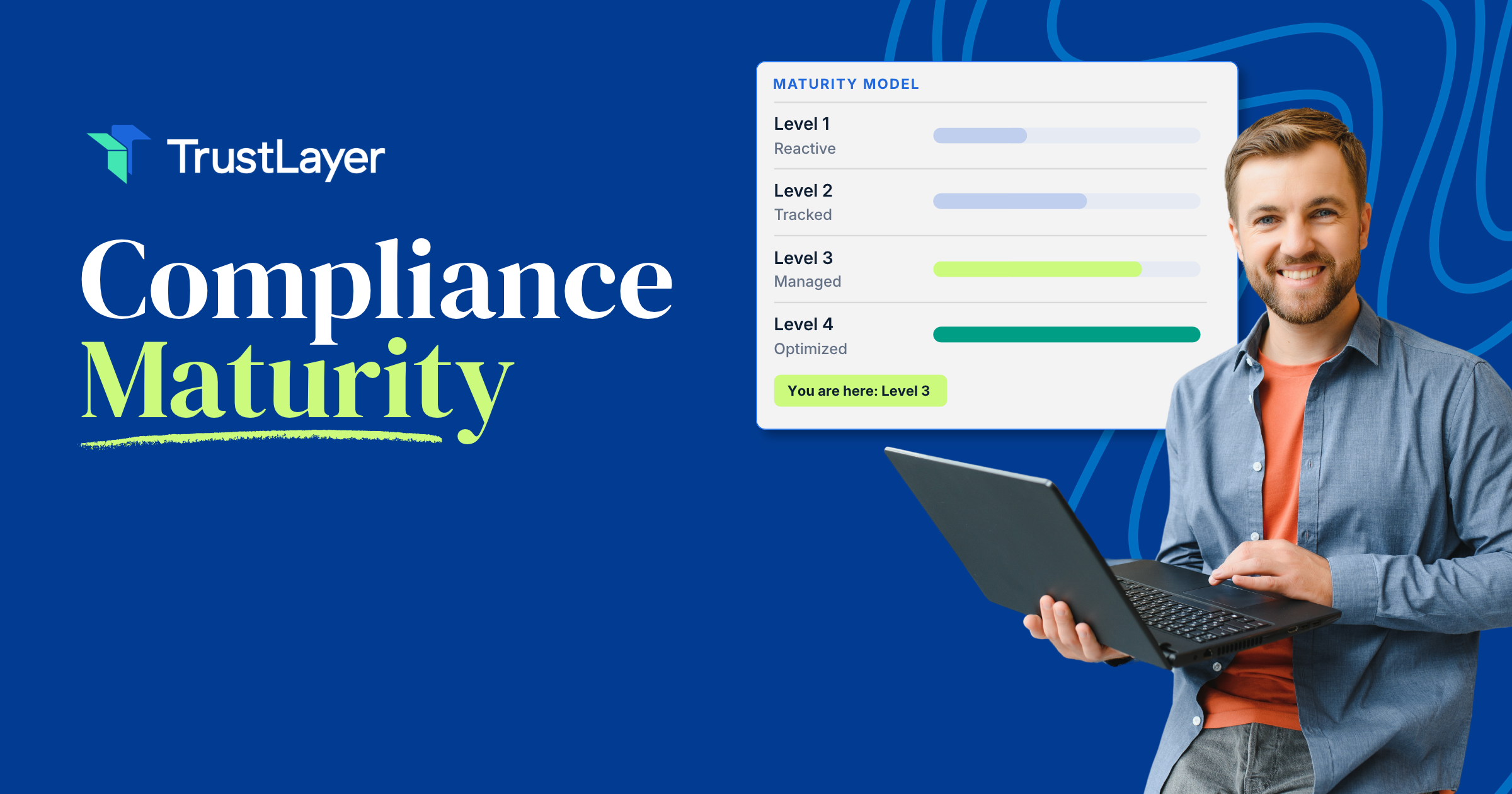
Most companies don't have a vendor compliance problem. They have a predictability problem. They can't say, on any given Tuesday, which subcontractors are covered, which certificates expired last week, or which vendor quietly dropped an endorsement at renewal. A compliance maturity model shows where your program stands and what it takes to reach compliance outcomes you can count on.
Plenty of risk managers I talk to assume their process is "fine" because nothing has blown up yet. That assumption is an expensive illusion. Gaps in vendor insurance rarely announce themselves. They sit quietly in a spreadsheet tab or an inbox folder until a claim forces them into the open, and by then the conversation involves lawyers instead of reminders.
The good news is that maturity is a sequence, not a mystery. Organizations tend to move through recognizable stages, and each one has its own failure modes and fixes. If you know which stage you're in, you can stop guessing and start building.
The Evolution of Vendor Risk Management
Vendor risk management used to be a filing exercise. A contractor showed up, someone in accounts payable asked for a certificate of insurance (COI), it went into a folder, and that was the end of it. Nobody checked whether the limits matched the contract, whether the additional insured language was actually there, or whether the policy would still be active in six months.
That approach held up when vendor rosters were small and relationships were local. It breaks down when a property management firm has 400 service providers across 30 buildings, or a general contractor runs dozens of active jobs with rotating subs. The volume alone makes the old model unworkable.
What changed wasn't just scale. Contracts got more specific about insurance requirements, insurers got more aggressive about denying coverage on technicalities, and courts kept reminding companies that "we had a certificate on file" isn't the same as "we were protected." A COI is evidence of coverage at a point in time. It isn't the coverage itself.
Organizations that adapted stopped treating compliance as paperwork and started treating it as risk control. That shift in thinking is what the maturity model formalizes.
Defining the Compliance Maturity Model
A compliance maturity model is a framework for assessing how reliably your organization collects, verifies, and maintains vendor documentation. It describes stages, typically from ad hoc and manual to automated and continuous, and lets you benchmark where you are against where you need to be. Think of it as a roadmap to predictable vendor compliance, not a scorecard to frame on the wall.
The value isn't in labeling yourself "Phase 2" and moving on. It's in understanding why each stage produces the results it does, and what specific changes move you forward.
From Reactive to Proactive Processes
Reactive compliance runs on fire drills. An audit is scheduled, a claim lands, or a client asks for proof, and suddenly three people spend a week chasing certificates and reconciling spreadsheets. Once the crisis passes, everyone goes back to ignoring the problem until the next one.
Proactive compliance is a constant state. Define requirements before a vendor starts work, check documents against those requirements on arrival, and trigger follow-ups before expirations occur. The difference isn't effort; it's timing. Reactive teams often work harder than proactive ones; they just do it at the worst possible moment.
The Role of Data Accuracy and Verification
Here's where a lot of programs fall apart. Collecting a certificate and verifying it are two completely different activities. A COI that lists general liability but omits the required additional insured endorsement is like a car with an engine and no wheels: it looks like the real thing in the driveway, but it won't take you anywhere when you need it.
Accurate data means knowing the actual limits, policy dates, endorsements, and named insureds, then comparing them against the contract. Without that verification step, a full document repository is practically worthless. You've built a library of reassuring PDFs that may not protect you.
Phase 1: Manual Tracking and the High Cost of Error
Phase 1 is where most organizations start and, frankly, where more of them remain than they would admit. Certificates arrive by email, fax, or in a vendor's glovebox. Someone logs them in a spreadsheet with columns for vendor name, expiration date, and maybe a notes field. Follow-up happens when somebody remembers.
The problems here are predictable:
- Single points of failure. One coordinator holds the whole system in their head. When they go on vacation or leave the company, institutional knowledge walks out with them.
- No real verification. Reviewers skim for an expiration date and move on, missing endorsement gaps, insufficient limits, or the wrong entity listed as insured.
- Fragmented visibility. Project managers collect some documents, site managers collect others, and central risk management sees only a partial picture.
- Time drain. Staff spend hours on phone calls and email threads just to confirm what a certificate says.
The data silo issue deserves extra attention. When a field team accepts a subcontractor's paperwork and never forwards it, the risk team has no idea that vendor is on site. That fundamental gap stays invisible until a worker gets hurt or a building floods, and then everyone discovers at once that nobody actually checked.
The cost of error in Phase 1 isn't wasted hours. It's the uninsured loss that lands on your balance sheet because a vendor's policy lapsed three months before the incident.
Phase 2: Digital Centralization and Standardization
Phase 2 begins when an organization decides to keep all vendor documents in one place and standardize requirements. This is a real improvement, and teams usually feel the relief immediately.
Centralization fixes the silo problem, at least on paper. Instead of documents scattered across inboxes and site trailers, risk management has a single source of truth. Standardization means requirements are written by vendor type: a landscaping crew gets one set of minimums, an electrical contractor another, and a software consultant a third.
The smartest organizations in this phase adopt a governance model I'd describe as centralizing control and decentralizing execution. Risk teams set the requirements, define what "compliant" means, and own oversight. Project leads and site managers handle the day-to-day work of requesting documents and onboarding vendors. This keeps the risk team from becoming a bottleneck that delays every job start, while still guaranteeing a consistent standard.
Phase 2 also forces a useful conversation about timing. For high-risk or regulated work, such as roofing, demolition, or anything involving hazardous materials, a synchronous approach makes sense: no compliant documents, no site access. For routine, low-risk vendors, an asynchronous pattern often works better, where work proceeds while documentation catches up, because the delay would do more damage than a short-lived gap.
The limitation of Phase 2 is that someone still has to check manually. Centralized doesn't mean monitored.
Phase 3: Automated Monitoring and Real-Time Compliance
Phase 3 is where vendor compliance stops being a periodic task and becomes continuous awareness. The defining feature isn't any particular piece of software. It's the shift from asking "are we compliant?" once a quarter to knowing the answer at any moment.
In practice, mature Phase 3 programs share a few traits. Requirements are tied directly to vendor categories and contracts. Expirations and deficiencies surface automatically rather than waiting for someone to notice. Follow-up with vendors happens on a schedule instead of on a whim. Leadership can pull a current compliance picture without commissioning a special report.
This matters because it ends compliance theater. Plenty of organizations scramble before an audit to produce tidy reports that show everything in order, then let things drift again afterward. That's performance, not protection. Real-time monitoring makes the audit a non-event because the program looks the same on audit day as it does every other day.
Automation also changes what your people do. Instead of chasing paperwork, risk professionals spend their time on judgment calls: whether to grant an exception, how to handle a vendor with a coverage gap they can't easily close, or which contract terms need revisiting. That's a far better use of expertise than reading expiration dates.
One caution: automation amplifies whatever foundation it sits on. If your requirements are vague or inconsistent, automating them just produces bad answers faster. Phase 3 only works if Phase 2 was done properly.
Achieving Predictable Compliance Outcomes
Predictability is the real payoff of a mature program. It means you can forecast your exposure, answer client and auditor questions without a scramble, and trust that a vendor flagged as compliant actually is. Getting there depends on two things that pull in slightly different directions: making life easier for vendors and tightening your own controls.
Reducing Administrative Friction for Vendors
Vendors aren't your adversaries in this process, even if it sometimes feels that way. Most of them want to get paid and get to work. When compliance requests are confusing, inconsistent, or arrive through five different channels, vendors stall, and your projects stall with them.
Reducing friction looks like a few practical habits:
- Send clear, specific requirements upfront, ideally with sample language for endorsements.
- Give vendors one place to submit documents instead of scattered email addresses.
- Tell them exactly what's wrong when a certificate falls short, not just "this doesn't work."
- Loop in their insurance broker early, since the broker usually has to make the fix anyway.
Vendors who understand what you need comply faster. That speed translates directly into fewer delayed job starts.
Mitigating Liability Through Continuous Tracking
Coverage is not static. Policies get canceled for nonpayment, renewed with lower limits, or reissued without endorsements that were present last year. A certificate that was perfect in January can be meaningless by July.
Continuous tracking closes that window. When you monitor documents throughout the vendor relationship, not just at onboarding, you catch lapses while there's still time to act, whether that means pausing work, requesting updated proof, or adjusting the contract. This is the difference between knowing about a gap and discovering it during a claim, which a mature program is meant to prevent.
Key Metrics for Measuring Your Maturity Level
If you can't measure your program, you can't make the case for improving it. Leadership doesn't care about how many PDFs you've filed. They care about business impact and program effectiveness, so frame your metrics accordingly.
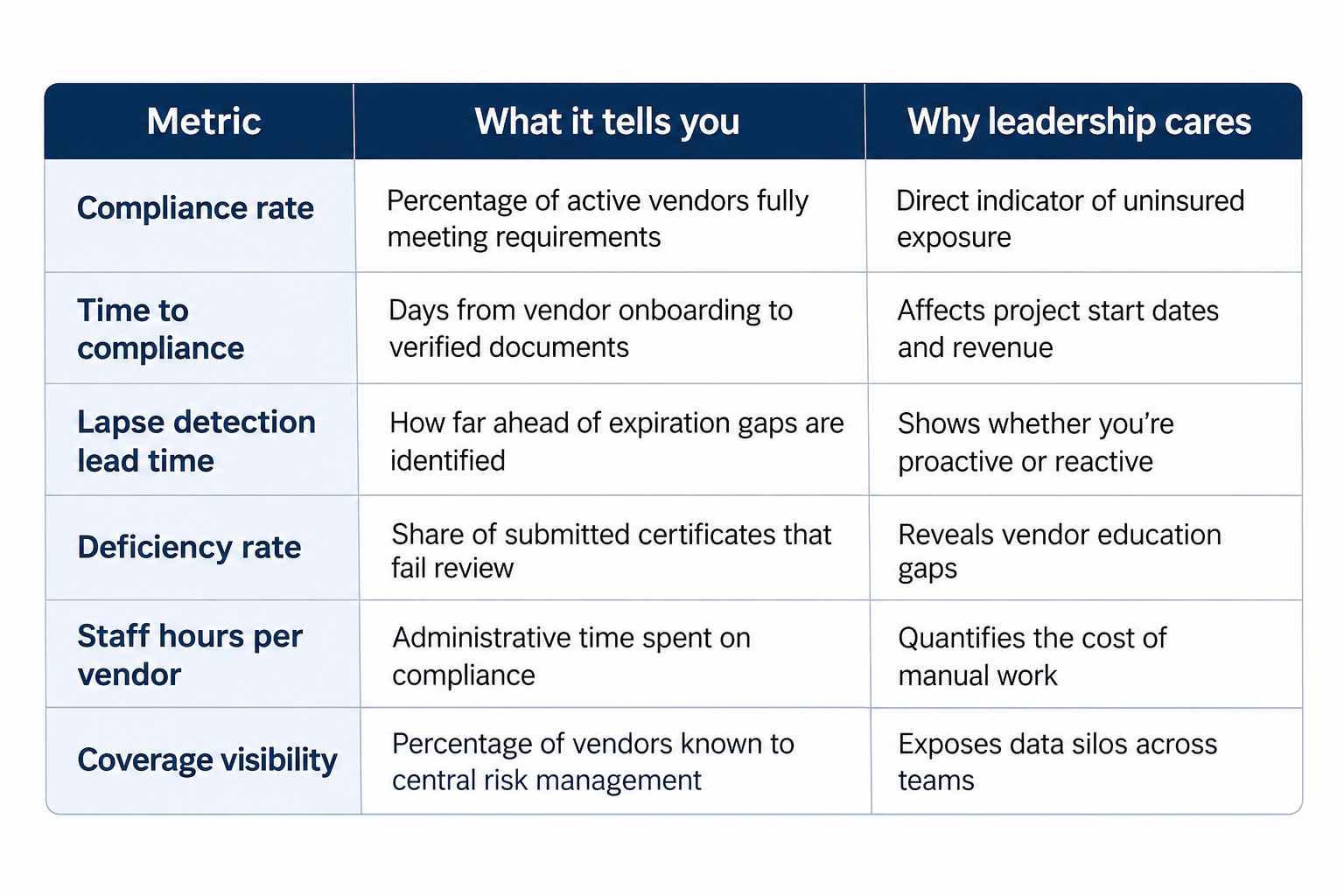
A Phase 1 organization usually can't produce most of these numbers, which is itself a diagnosis. Phase 2 teams can calculate them with effort, often by exporting and cleaning spreadsheets. Phase 3 teams see them continuously.
Pay special attention to coverage visibility. If your risk team knows about only 70 percent of the vendors actually working for you, every other metric rests on an incomplete foundation. Fix that first.
Next Steps for Strengthening Your Compliance Framework
The path from scattered spreadsheets to predictable compliance doesn't happen in one leap, and it shouldn't. Start by honestly assessing which phase you're in, then fix the foundations before you try to automate anything. Write down requirements by vendor type, pull every document into one place, settle who owns oversight versus execution, and decide which work demands documents before day one.
From there, push toward continuous monitoring so compliance becomes a sustainable practice rather than a recurring fire drill. The organizations that get this right aren't working harder. They simply stopped relying on luck and memory to protect them.
If you want help building the structural groundwork that makes intelligent automation and real risk control possible, TrustLayer was built for modern risk managers who are done with paper-chasing and phone tag. Set up a time to talk with our team and get advice from our insurance experts on where your program stands and what to tackle next. For more practical guidance on certificates of insurance, vendor requirements, and risk management, browse the other articles on the TrustLayer blog.
You might also like