The CRE Vendor Compliance Blind Spot: On-Site Vendors vs Tenants

Most commercial property teams can tell you, within a day or two, which tenants have lapsed insurance. Ask them which HVAC subcontractor was on the roof last Tuesday, and whether that crew's general liability policy was active, and the room tends to go quiet. That silence is the CRE vendor compliance blind spot: on-site vendors vs tenants, two groups that create very different risks but often get tracked with the same tired spreadsheet.
The irony is that vendors frequently carry more physical risk than the tenants themselves. A law firm leasing the 14th floor sits at desks. The window-washing contractor hanging off the side of that building does not. Yet the lease gets a careful legal review while the window crew gets a quick nod at the loading dock.
This gap rarely shows up in a quarterly report. It shows up when someone gets hurt, files a claim, and the property owner discovers that the paperwork in the file never matched the coverage that actually existed. By then, the cleanup is legal, financial, and reputational all at once.
The Hidden Risk Profile of Commercial Real Estate Operations
A commercial building is a moving system. On any given week, an office tower or mixed-use property might host janitorial crews, elevator technicians, security guards, landscapers, pest control, fire alarm inspectors, IT cabling contractors, and a rotating cast of tenant improvement subs. Each of them brings ladders, chemicals, power tools, and people into a space the owner is ultimately responsible for.
Tenants, by contrast, are relatively predictable. Their risk is defined by a lease, renewed on a known schedule, and backed by a certificate of insurance (COI) that usually gets reviewed at move-in and at renewal. The relationship is long, formal, and documented.
The operational risk profile of a property is weighted toward the people who touch the building, not just the people who occupy it. Slip-and-fall claims, property damage from a botched plumbing repair, a fire started by a roofing torch: these incidents tend to trace back to service work, not to a tenant answering emails.
That's the uncomfortable math. Property teams spend the most compliance effort on the lowest-motion group and the least on the highest-motion one. It isn't negligence so much as habit, and habits built around leases don't translate well to a world of weekly service tickets.
Why On-Site Vendors Create Unique Liability Gaps
Vendors create liability gaps because they arrive through many doors at once. A tenant has one relationship with the landlord. A vendor might be hired by the property manager, by a tenant directly, by a general contractor working for a tenant, or by a sub-subcontractor nobody at the property has ever met.
Each of those paths has its own paperwork expectations, and they rarely line up. The property manager might require $2 million in general liability and additional insured status. The tenant who hired a furniture installer might not require anything at all. When that installer gouges a freight elevator, the owner finds out who was responsible only after the fact.
Then there's the problem of fragmented visibility. Site managers know who shows up. Central risk teams know what the contract says. Accounting knows who got paid. Those three data silos almost never talk to each other in real time, which means a coverage gap can sit undetected for months, waiting quietly until a claim pulls it into the open.
The short duration of vendor work makes everything worse. A three-hour job doesn't feel worth chasing paperwork for. But a three-hour job with a ladder and an uninsured worker can produce a seven-figure lawsuit, and the court won't care how brief the visit was.
Comparing Tenant vs. Vendor Compliance Workflows
Putting tenant and vendor workflows side by side shows why one process can't serve both. They differ in frequency, ownership, contract structure, and how fast things go stale.
The table makes the core point plainly. Tenants are a filing problem. Vendors are a flow problem.
Static Tenant COIs vs. Dynamic Vendor Schedules
A tenant COI behaves like a fixed asset. It gets collected, reviewed against lease requirements, and calendared for renewal. If the tenant's policy renews every January, the property team knows exactly when to ask for an updated certificate.
Vendor schedules don't cooperate like that. A plumbing company might be on site twice this month and not again until fall. Its policy might renew in March, but its crew might show up in April with a certificate that expired three weeks earlier. A COI collected once at onboarding and never revisited becomes an expensive illusion: it looks like protection in the file but offers nothing on the day it matters.
Contractual Indemnity and Additional Insured Status
Leases typically spell out indemnity and additional insured requirements in detail, and legal teams negotiate them carefully. Vendor agreements are often a one-page purchase order or, worse, a verbal arrangement.
Think of a COI without the right endorsements like a car with an engine but no wheels. Everything looks fine under the hood, yet it won't take you anywhere. A certificate can list a policy and limits but still fail to name the property owner as additional insured, or the underlying contract may lack the indemnity language that makes that status meaningful. Without both pieces, the document is practically worthless when a claim lands.
Common Blind Spots in Short-Term Vendor Management
Short-term vendors are where most compliance programs quietly fall apart. The issues tend to repeat across portfolios, which is actually good news: predictable problems can be fixed.
- Tenant-hired contractors: A tenant brings in its own electrician for a weekend job, and building management never sees a certificate. The owner still carries exposure because the work happens in the owner's building.
- Emergency callouts: A burst pipe at 2 a.m. gets fixed by whoever answers the phone. Nobody checks insurance at that hour, and nobody goes back to check it later.
- Sub-tier subcontractors: The roofing contractor is covered. The two-person crew it subcontracted to is not, and nobody asked.
- Expired-on-arrival certificates: The vendor submitted a valid COI last year. It lapsed, and the file still shows green.
- Lookalike limits: The certificate shows $1 million per occurrence when the contract required $2 million, and a busy coordinator skimmed past it.
- Missing workers' comp: Small vendors sometimes claim exemptions or carry no coverage at all, shifting injury exposure back toward the property.
None of these are exotic. They happen because short jobs feel low-stakes and nobody owns the follow-up. The fix starts with assigning that ownership, not with adding another form.
The Financial Impact of Untracked Service Providers
The cost of an untracked vendor rarely shows up as a line item. It surfaces through the owner's own insurance program, as claims that should have been tendered to someone else's carrier land on the property policy instead.
Here's a realistic scenario. A landscaping subcontractor's employee is injured on site, and the subcontractor has no active workers' compensation policy. The injured worker's attorney looks for the deepest pocket nearby, which is usually the property owner. The owner's carrier pays, the loss history worsens, and the next renewal comes in higher. A single uninsured visit can echo through premiums for years.
There are softer costs, too. Legal fees accumulate while teams try to reconstruct who hired whom. Lenders and investors sometimes ask pointed questions about risk controls during refinancing or due diligence. Staff hours vanish into document hunts that a clean record would have avoided.
Leadership tends to respond to this framing better than to compliance language. Instead of reporting "92% of vendors compliant," report business impact: claims successfully tendered to vendor carriers, dollars of exposure transferred, and gaps closed before work started. Those numbers speak to program effectiveness, and they make the case for investment far better than a percentage on a slide.
Best Practices for Mitigating On-Site Operational Risk
The strongest programs share one structural idea: centralize control, decentralize execution. Risk management sets the standards, including required limits, endorsements, and contract language, and owns the strategic view across the portfolio. Site and property managers handle day-to-day execution, because they're the ones who actually see who walks through the door.
When everything routes through a central risk team, approvals bottleneck and site staff start working around the process. When everything sits with sites, standards drift property by property. Splitting the roles keeps both consistency and speed.
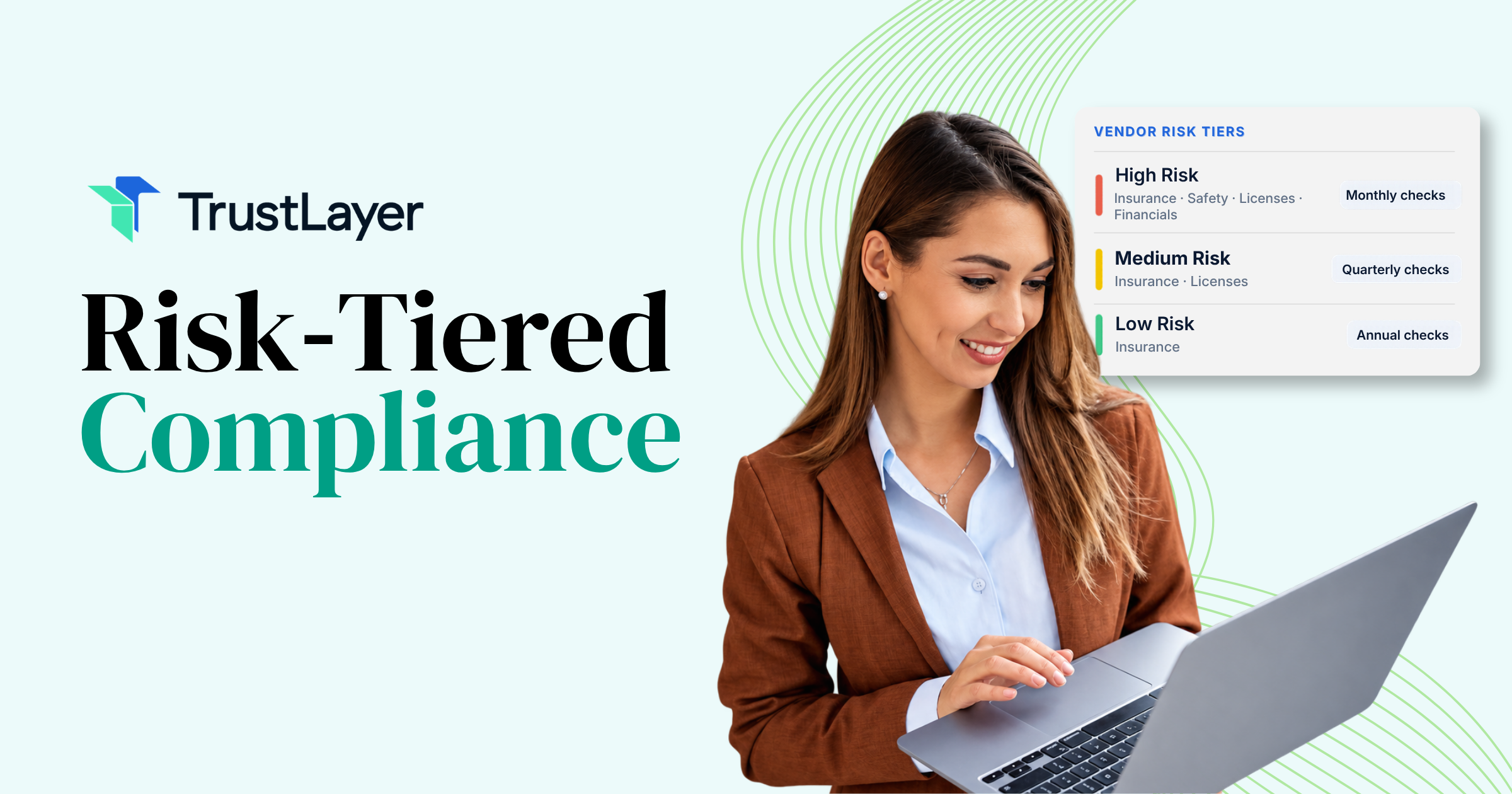
It also helps to match the workflow to the risk. Synchronous verification, where work cannot begin until compliance is confirmed, belongs with high-risk or regulated activities such as roofing, elevator work, hot work, and crane operations. Asynchronous verification, where the request goes out and follow-up happens in parallel, suits routine services like plant care or document shredding, where holding the job would cause more damage than a short documentation gap.
Automating Verification for High-Frequency Vendors
Janitorial, security, and maintenance vendors may be on site every single day. Manually rechecking them is where coordinators burn out and mistakes creep in. Automated reminders before expiration, standardized requirement templates by vendor type, and clear escalation paths keep these relationships current without someone babysitting a spreadsheet.
The goal is to move away from the fire drill. Too many teams scramble before an audit or after an incident, pulling certificates from inboxes in a panic. A constant state of readiness, where status is always known, is a far more sustainable practice.
Integrating Compliance with Access Management
Insurance status should connect to physical access. If a vendor's certificate has lapsed, that vendor's badge or access credential should flag at the security desk or loading dock. Compliance that lives only in a file cabinet can't stop anyone from walking in.
Even a simple version works: give front-desk and dock staff a current list of approved vendors, refreshed daily. Train them with real scenarios, such as "a tenant's contractor shows up without being on the list," rather than a checkbox video nobody remembers. Role-specific training tied to their actual daily tasks is what changes behavior.
Leveraging Technology to Close the Compliance Loop
Spreadsheets were never built for a population that changes weekly. They can store a certificate's expiration date, but they can't tell you whether the endorsement matches the contract, whether the vendor was on site yesterday, or whether a tenant hired someone off the books.
Technology closes the loop by connecting the pieces that currently live in separate silos: contract requirements, certificate details, site activity, and follow-up. When those connect, the property team stops guessing and starts knowing.
The real shift is mental, not mechanical. Dashboards that update continuously change the culture from periodic reporting to continuous awareness. Instead of building a compliance package for an auditor once a year, the team can answer "is everyone on site right now covered?" at any moment. That ends the compliance theater of polished binders that nobody trusts and replaces it with a live picture of actual risk.
When evaluating tools, ask practical questions:
- Can it handle different requirements for tenants versus vendors, and for different vendor types?
- Does it give site managers simple tasks while giving risk leaders a portfolio view?
- Can it produce reports framed around exposure and outcomes, not just counts?
- Will vendors and tenants actually use it, or will they ignore the emails?
That last question matters more than most buyers expect. A tool vendors won't touch just moves the bottleneck somewhere new.
Strengthen Your Portfolio with TrustLayer Experts
The gap between on-site vendors and tenants comes down to one fundamental mismatch: properties track their most stable relationships carefully and their most active ones loosely. Tenants sign leases and renew on schedule. Vendors show up, do risky work, and leave, often before anyone confirms they were covered. Fixing that means treating vendor compliance as a flow, splitting strategy from execution, matching verification speed to risk, and tying insurance status to who can physically enter the building.
If your team is ready to stop chasing certificates and start building the structural foundation that smarter automation and real risk management depend on, TrustLayer is a strong place to start. Its COI tracking is built for modern risk managers who would rather prevent the next claim than explain it. Set up a time to talk with our team and book a consult with our insurance experts.
For more practical guidance on vendor risk, certificates of insurance, and building a forward-leaning compliance program, browse the other articles on the TrustLayer blog. The next uninsured crew on your roof won't announce itself, so the time to close the gap is before they arrive.
You might also like