You Do the Risk-Management Work. You Just Can’t Prove It — Yet.

The case for Certified Risk Transfer™
There's a business out there — maybe it's yours — that does everything right.
It collects a certificate of insurance from every vendor before they set foot on site. It enforces Additional Insured endorsements. It chases down expired coverage. It has a person, or a team, or software, whose whole job is making sure that when a subcontractor makes a mistake, the subcontractor's insurance responds — not theirs.
And at renewal, that business walks into the room and gets priced almost exactly like the company down the street that does none of it.
Not because their underwriter is lazy. Because their underwriter is blind.
Underwriting can't see your best work
Here's what a commercial underwriter actually sees when they price your account: your industry code, your payroll, your revenue, your loss runs. Maybe a supplemental application. Maybe a phone call.
Here's what they almost never see: whether you actually control the risk you hand to third parties.
That's a strange gap, because third-party risk is one of the biggest drivers of unexpected loss in commercial lines. Every vendor, supplier, and subcontractor you work with is a claim that can land on your policy if their coverage has a hole in it. The businesses that manage this well are meaningfully different risks than the businesses that don't.
But underwriting has no reliable way to tell them apart. So it prices for the blended pool — which means the diligent operators quietly subsidize the negligent ones. You do the work. The market can't see it. So the market can't reward it.
You walk into renewal with a spreadsheet and a story. Stories don't move actuarial models.
A quick vocabulary check
If you live in this world daily, skip ahead. If not, four terms in plain English:
Contractual risk transfer is the practice of shifting risk to the party that created it. Your subcontractor drops a beam; your subcontractor's insurance pays. It's done through contract language and insurance requirements — you require your vendors to carry coverage that protects you.
A COI — certificate of insurance — is the one-page document that says a vendor’s coverage exists. It’s a snapshot, not a guarantee. It can be outdated the day after it’s issued. It can be doctored. Most businesses collect them, file them, and never verify them. If you want a deeper look at what a COI does — and what it does not prove — this TrustLayer guide breaks it down.
The "big three" endorsements are what make risk transfer actually work: Additional Insured (their policy protects you too), Waiver of Subrogation (their insurer won’t come after you), and Primary & Non-Contributory (their coverage pays first). When these are missing or written wrong, the risk quietly boomerangs back to the hiring party — usually discovered after the loss, when it’s too late. TrustLayer’s guide to insurance endorsements explains why the COI alone is never the whole story.
Subrogation is how your carrier recovers a paid claim from the third party who actually caused it. When endorsements are broken or claims are tendered late, those recoveries fail — and failed recoveries eventually show up in everyone's premiums.
Managing all of this, continuously, across every vendor relationship, is third-party risk management. Some companies do it exceptionally well. And today, they have no way to prove it.
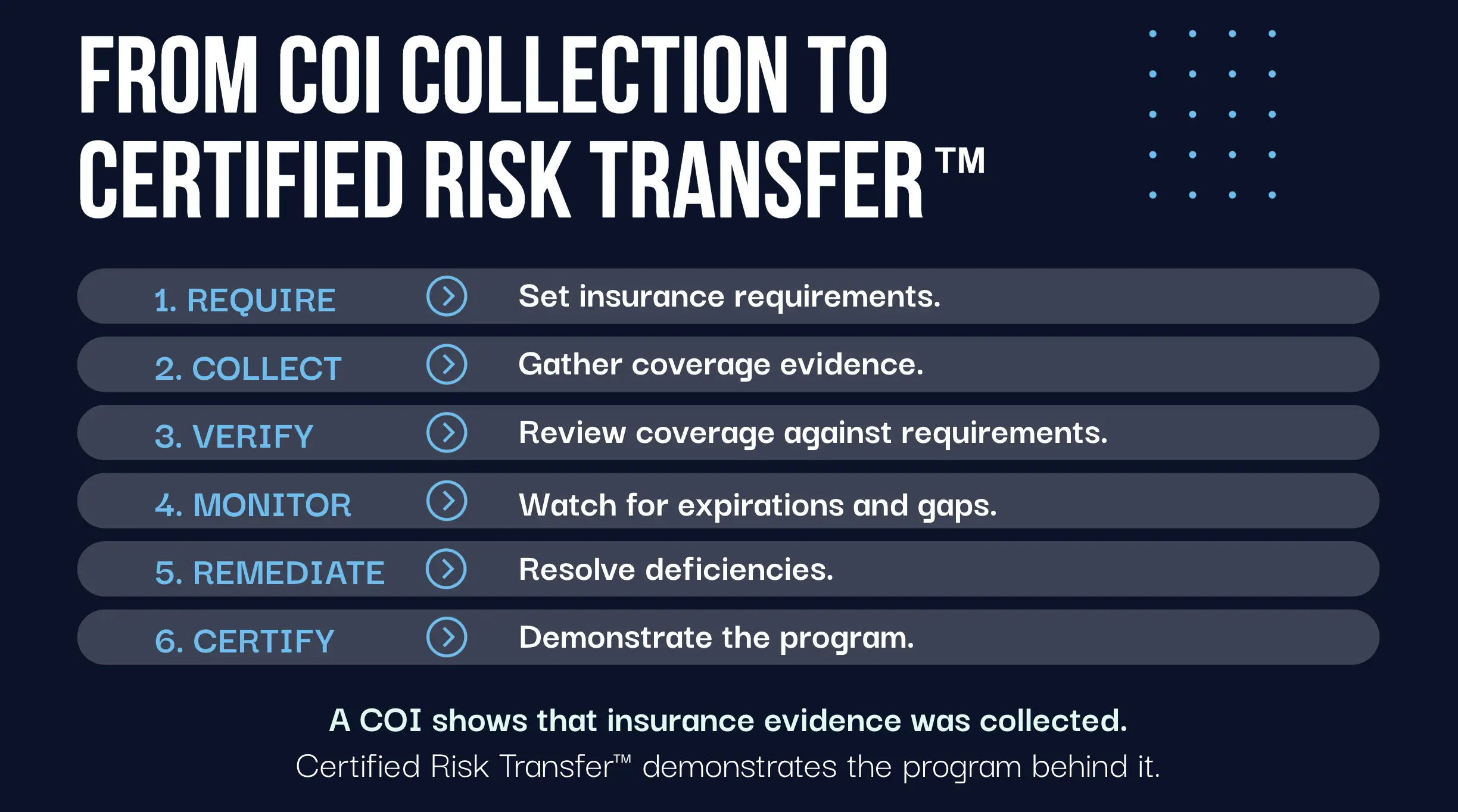
Bottom line: A COI shows that insurance evidence was collected. Certified Risk Transfer™ demonstrates the program behind it.
What Certified Risk Transfer™ is
Certified Risk Transfer™ turns that invisible work into a verifiable credential.
The idea is simple: independently verify that a business's risk-transfer program is real and working — the certificates are collected and validated, the endorsements are enforced, lapses are caught and remediated, the monitoring is continuous — and issue a certificate that says so.
Not a certificate of insurance. A certificate of program. One document that says: this company doesn't just require coverage from its vendors, it verifies it, enforces it, and can show its work.
That document is portable. The insured can hand it to their broker. The broker can put it in front of underwriting. The carrier can treat it as a first-party signal about the quality of the risk — because it's built on verified facts, not self-reported answers on a supplemental app.
If you want the 5-minute version of how the concept works, read What Is Certified Risk Transfer™
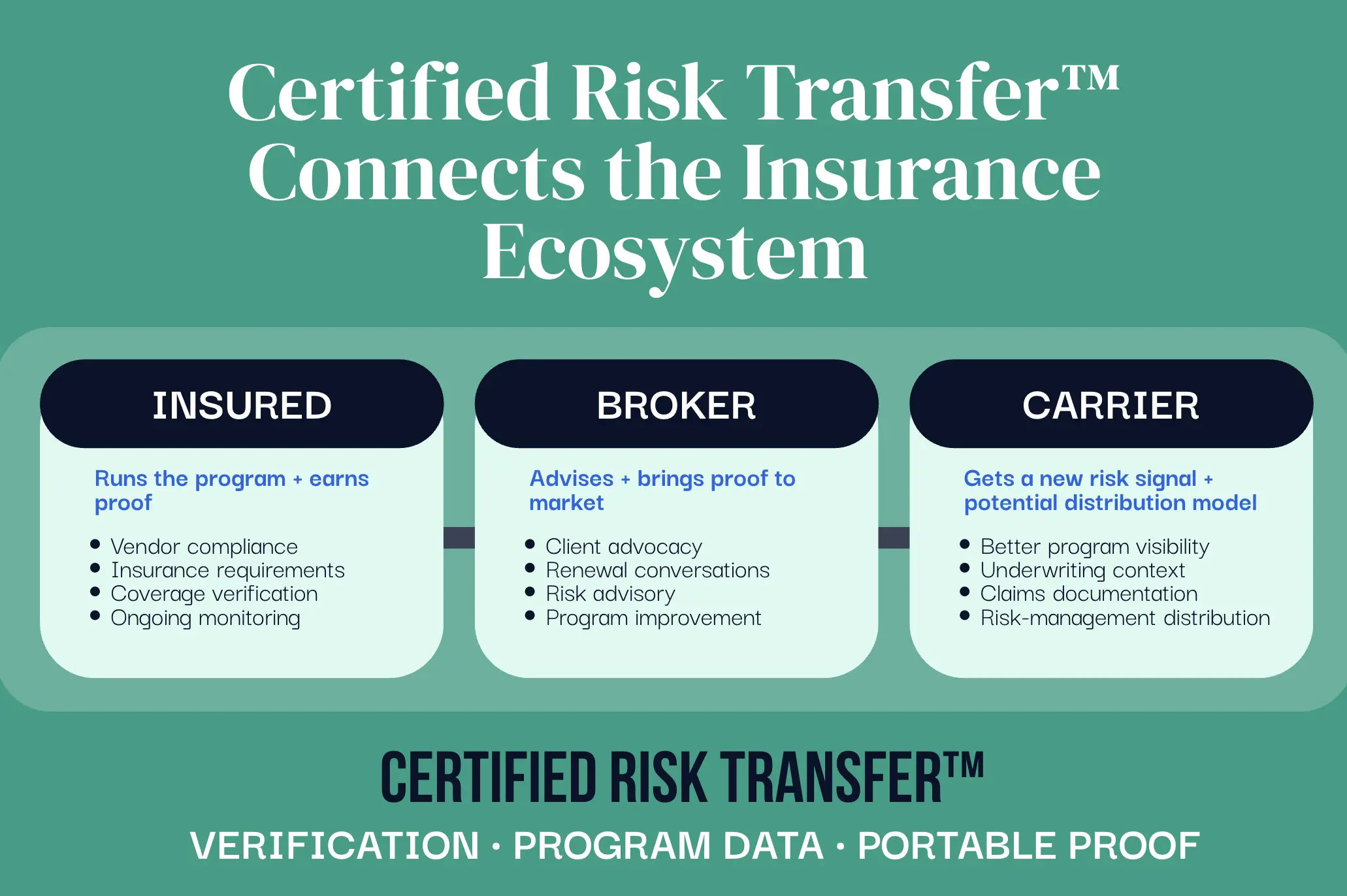
Why proof changes the game for all three seats at the table
For you, the insured, certification converts compliance hygiene from a cost center into an asset. All that COI-chasing, endorsement-checking work you already pay for finally produces something you can show — a credible document at renewal, and a real basis for a more sophisticated conversation about terms, structure, and market access. Carriers may consider documented controls in underwriting; the conversation at renewal can change. And separately from any insurance outcome, a certified program simply makes you operationally safer. Fewer coverage gaps means fewer claims landing where they don't belong.
For your broker, this is a reason to consult, not just quote. Brokers have spent a decade looking for advisory value beyond the placement — something concrete to bring clients between renewals. Guiding a client toward certification is exactly that: a defined engagement, a measurable outcome, and a differentiated posture at renewal. The broker who walks into a market with a certified account isn't telling a story about their client's controls. They're presenting evidence.
For your carrier, certification is a selection signal and a claims accelerator. On the front end, it's information underwriting has never had: which insureds actually run a real risk-transfer operation. On the back end, it pays off when a loss happens — a certified program means the endorsements are in place, the documentation exists, and the claim can be tendered to the responsible party's carrier cleanly and fast. Recoveries fail on broken paperwork. Certification is, among other things, a subrogation-readiness standard.
And there's a fourth beneficiary: the relationship itself. When the insured, the broker, and the carrier are all working from the same verified facts, friction drops. Fewer disputes about what was in place. Fewer surprises at claim time. Faster renewals, because the diligence is already done.
The precedent already exists — in your house and your car
If this sounds novel, it isn't. Personal lines figured it out years ago.
Install a connected water-leak sensor in your home, and your insurer can treat your house as a different risk — because the device proves the protection is real. Drive with a telematics app, and your carrier prices your actual driving instead of your demographic. In both cases, the mechanism is identical: verifiable proof of behavior replaces assumption, and the market responds to proof.
Commercial third-party risk has never had its sensor. The work happened — or didn't — inside spreadsheets and shared inboxes, invisible to everyone pricing the account. Certified Risk Transfer™ is that sensor: continuous, verified evidence that a company's risk-transfer program is functioning.
What telematics did for auto insurance, proof can do for contractual risk.
Why this is possible now
The honest answer for why this didn't exist ten years ago: it couldn't.
Verifying a single COI properly — confirming the policy is active, the limits match the contract, the endorsements are actually attached — is tedious. Doing it across hundreds of vendor relationships, continuously, catching every mid-term cancellation and lapse? That was never going to happen with people and spreadsheets. So "verification" became "collection," and everyone quietly accepted that the documents in the folder might not mean anything.
That constraint is gone. Verification and monitoring are now automatable at scale — policies can be checked against requirements continuously, gaps surfaced as they open, and remediation tracked to closure. Which means, for the first time, a program can be audited rather than asserted. And once something can be audited, it can be certified. And once it can be certified, the market can finally see the difference between businesses that do this work and businesses that don’t.
An invitation, not a pitch
Certified Risk Transfer™ is a category we think should exist — because every party in commercial insurance is better off when diligence is visible.
If you're a risk manager: the work you're already doing deserves to count for something at renewal. Start by asking a simple question — if an underwriter asked me to prove my vendor risk program works, what would I hand them? If the answer is a spreadsheet, that's the gap.
If you're a broker: your best clients are under-credited for their controls, and you're the one positioned to change that.
If you're a carrier: there's a selection signal sitting in the market that nobody's underwriting on yet.
The businesses doing this work have been invisible long enough. The conversation at renewal can change.
Can you prove your risk-transfer program works?
See how TrustLayer helps teams verify coverage, monitor compliance, and build a risk-transfer program they can actually show.
You might also like
.png)