What Is Certified Risk Transfer™? (A Plain-English Explainer)
The 5-minute version of the idea that could change your next insurance renewal.
You understand why you have insurance. Something goes wrong, you file a claim, the policy makes you whole. That's the ancient premise — coverage for everything that might happen.
Here's the part nobody explains until it's expensive: what happens after the claim.
File one, and there's a real chance you're looking at higher premiums at renewal. File a bad one — or a few — and you could be looking at non-renewal. In some cases, and this happens every day to businesses of all sizes, you become functionally uninsurable.
Now the kicker: what if the loss wasn't even your fault?
A vendor's crew caused the damage. A supplier's failure triggered the loss. A subcontractor's mistake started the whole thing. In a fair world, that claim runs through their insurance — and your record, your premiums, your insurability stay clean.
Whether that actually happens depends on something most businesses have never heard named: risk transfer.
Risk transfer, in one sitting
Risk transfer is the practice of pushing risk downstream to the party that created it. You do it through two mechanisms working together:
- Contract language that says your vendors are responsible for their own mistakes, and
- Insurance requirements that make sure they carry coverage capable of backing that up.
When it works, you're never left holding the bag for someone else's error. When it doesn't — when the vendor's policy lapsed, or the limits were too low, or the paperwork was wrong — their risk becomes your claim. Your loss run. Your renewal problem.
The most basic building block of risk transfer is the certificate of insurance, or COI — a one-page document proving a vendor's coverage exists.
Every business that works with third parties should be collecting them. Most do, sort of. Here's the problem: a COI is a snapshot. It can be expired a week after it's issued. It can be missing the endorsements that actually protect you.
It can, bluntly, be faked. A folder full of COIs is not the same thing as being protected.
The three lines of fine print that decide everything
Whether a vendor's insurance actually protects you usually comes down to three endorsements. In plain English:
- Additional Insured — their policy covers you too, not just them.
- Waiver of Subrogation — their insurance company agrees not to come after you to recover what it paid.
- Primary & Non-Contributory — their coverage pays first, before yours is ever touched.
When these are in place and correct, risk flows downstream the way it should. When any one of them is missing or written wrong, the risk quietly boomerangs back to you — and you typically find out at the worst possible moment, which is after the loss.
Verifying these across every vendor, continuously, is the real work of vendor insurance compliance. It's tedious, it's detailed, and it's exactly the kind of work that separates well-run risk programs from folders of paper.
The COI is never the whole story, because the endorsements behind it can determine whether the protection you expected is actually there.
So what does "Certified" add?
Here's the frustrating part for businesses that do this work well: nobody can see it.
When your insurance gets priced, the underwriter sees your industry, your size, your loss history. They see almost nothing about whether you actually verify vendor coverage, enforce the right endorsements, and catch lapses before they become gaps.
The company that runs a rigorous program and the company that shoves COIs in a drawer look nearly identical from the underwriter's chair.
You've done the work. You just can't prove it. And in insurance, what can't be proven can't be rewarded.
Certified Risk Transfer™ closes that gap. It means your third-party risk program — the collection, the verification, the endorsement enforcement, the ongoing monitoring — has been independently verified as real and working, and you hold a certificate that says so.
Not a certificate of insurance. A certificate of program.
For the larger argument behind why we think this category should exist, read the case for Certified Risk Transfer™.
Why that piece of paper matters
Think about what changes when the most organized person in the room about their risk program can prove it:
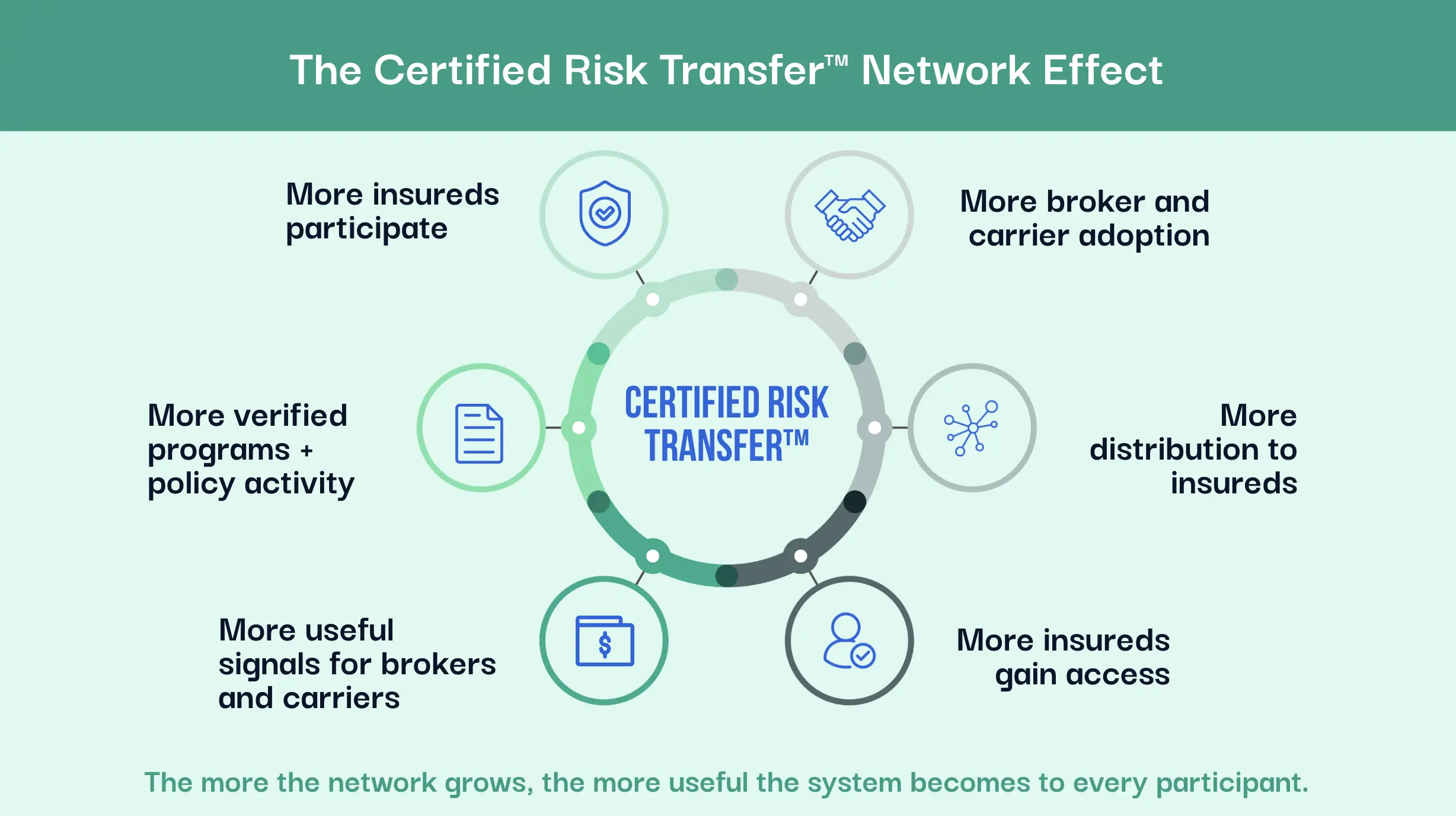
Your renewal conversation changes. Instead of walking in with a spreadsheet and a story, you and your broker walk in with evidence. That gives your broker a real basis to advocate for you — on terms, on structure, on access to the markets that want well-run risks. Carriers may consider documented controls in underwriting. The conversation at renewal can change.
Your operations change. A verified program means fewer coverage gaps, which means fewer claims landing on your policy that never should have been yours. That protects the thing that's genuinely hard to rebuild: a clean loss history.
Your leverage changes. Flip the seats for a second. If you were the underwriter, who would you rather insure — the business that can prove its downstream risk is controlled, or the one that can't? And if you had to take the second one, wouldn't you price for the uncertainty? The higher the perceived risk, the higher the premium. Proof removes the guesswork — in your favor.
There's a precedent for this in your personal life. A connected leak sensor in your home, a telematics app in your car — in both cases, your insurer can treat you as a different risk because the proof exists. Certified Risk Transfer™ brings that same principle to commercial third-party risk: verifiable proof that can inform how risk is understood and priced.
Where to start
You don't have to overhaul everything tomorrow. But this is arguably the highest-impact place to start as you mature your risk program, because it's foundational: nearly every other risk-management improvement builds on knowing your third-party exposure is controlled.
A simple self-audit, three questions:
- Do you know how many vendors, suppliers, and subcontractors you work with? (The real number is usually 2–3x the guess.)
- Could you show, today, which of them have current, compliant coverage with the right endorsements?
- If an underwriter asked you to prove your program works, what would you hand them?
If question three lands on "a spreadsheet," you've found the gap — and the opportunity. Because when you start having great conversations about how you're becoming less risky, you open the door to better outcomes across your whole insurance program. And those improvements compound over time.
That's the 5-minute version.
Can you prove your risk-transfer program works?
Collecting a COI is one step. Knowing whether the coverage behind it meets your requirements — and stays that way — is another.
See how TrustLayer helps teams verify coverage, monitor compliance, and identify the gaps that can undermine risk transfer.
See How TrustLayer Helps Verify Risk Transfer
You might also like
.png)